

Overview
A leading data-driven enterprise collaborated with Banao Technologies to streamline its massive information management workflow. The objective was to automate manual content categorization and data tagging using AI and NLP models, enabling faster document processing, improved data accuracy, and enhanced search relevance across millions of records.
Industry
SAASBusiness type
Enterprise SaaS Solution
Services
AI & Machine Learning Development | Natural Language Processing (NLP) | Backend System Architecture
Build your idea
Consult our experts
Impact After Launch
Post-deployment, the platform achieved remarkable accuracy in content classification and data tagging. The AI-powered pipeline significantly reduced human dependency, streamlined metadata enrichment, and enhanced enterprise search functionality. The system also allowed real-time tagging for new data inflows, leading to better information retrieval and analytics performance.
Key results achieved after deployment
0+
automated content items tagged by the system,
0+
faster document processing time, and
0%
reduction in manual data annotation effort.
Challenge
The client managed an ever-growing repository of documents, reports, and content assets. Manual data tagging led to inefficiencies, inconsistencies, and delays in data retrieval. The organization needed a scalable AI-driven system to automatically classify, tag, and enrich large volumes of data while ensuring semantic accuracy.
Our Solution
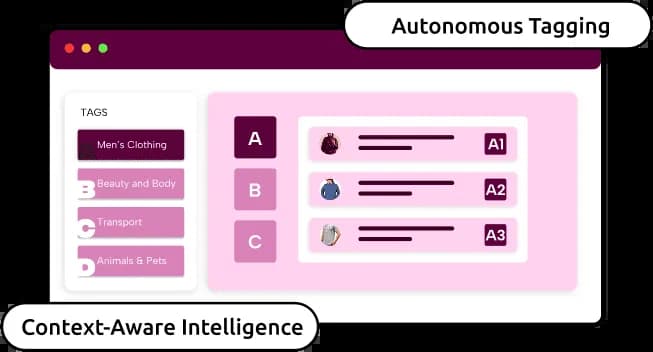
Banao Technologies designed and implemented a fully automated content tagging engine powered by NLP and deep learning models. The system analyzed contextual meaning within unstructured data, identified relevant topics, and assigned metadata tags with high accuracy. The architecture was built to scale for real-time data ingestion and tagging through APIs.
Features Implemented:
- AI-based tagging using NLP and semantic analysis
- Automated metadata extraction for documents and media files
- Customizable taxonomy and ontology management
- Scalable data ingestion and API-driven processing

Key Features Implemented
An intelligent automation platform for enterprise-scale data tagging and metadata management.
Contextual NLP Tagging
Analyzes text meaning and assigns accurate, context-aware tags to structured and unstructured data.
Dynamic Taxonomy System
Allows administrators to manage and update tagging hierarchies, keywords, and content categories on the fly.
Real-Time Processing Pipeline
Handles large-scale data ingestion and tagging with minimal latency through microservice-based APIs.
Analytics & Accuracy Monitoring
Continuously tracks tagging performance and suggests model improvements using feedback loops.
Where we're located




Frequently Asked Questions
What technologies were used in the solution?
The system utilized advanced NLP frameworks such as spaCy and BERT for contextual tagging, supported by a scalable Python-based microservice backend.
How accurate is the automated tagging?
The AI tagging engine achieved over 94% accuracy across diverse data categories after iterative model training.
What were the operational improvements?
The solution reduced manual tagging efforts by over 50% and improved search response times by 70%.
Can the platform be adapted for other industries?
Yes, the architecture supports domain-specific customization, making it adaptable for legal, healthcare, finance, and media sectors.