AI · Computer vision quality inspection

Computer-vision quality inspection that catches the defect a tired inspector waves through

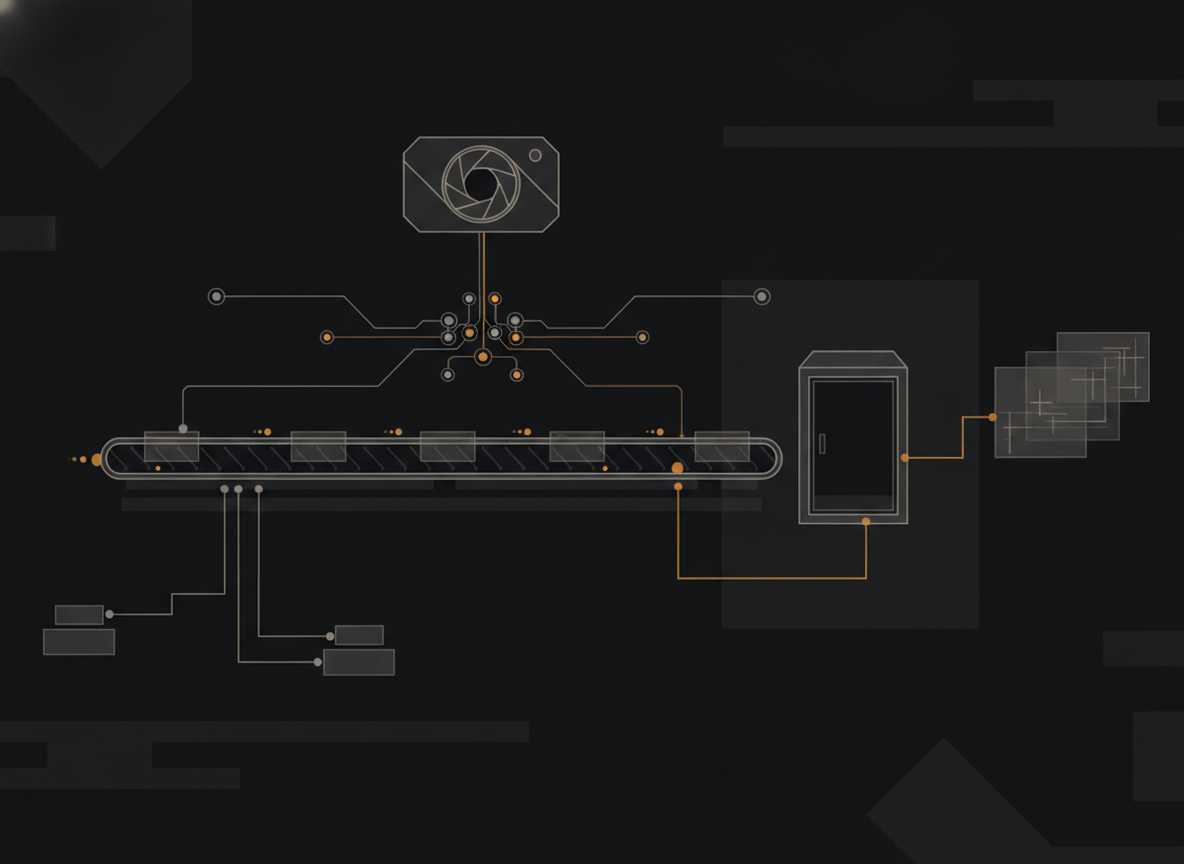
Banao builds computer-vision quality inspection that runs on your line — cameras and models that grade every unit for surface defects, missing components, wrong labels, and out-of-spec dimensions, then signal your PLC to pass or reject before the part moves on.

We deliver the whole system, not a notebook: the dataset, the trained models, the edge hardware, the line integration, and the drift monitoring that keeps accuracy from sliding three months after go-live. It is built to the production standard we hold the AI that runs our own company to.

RAK Ceramics— we put computer-vision inspection on a live ceramics production line in the UAE.

What we build into a vision inspection line

A vision system in production is not one model. It is the camera, the light, the dataset, the trained model, the line integration, and the monitoring that keeps it honest — we own all of it.

Surface and cosmetic defect detection

Models that flag scratches, cracks, chips, dents, contamination, and finish flaws on each unit — the cosmetic defects a human catches on a good day and misses on the third shift.

Dimensional and gauge inspection

Sub-pixel measurement of dimensions, gaps, and alignment against your tolerance, so an out-of-spec part is rejected on the line rather than found by a customer.

Assembly and completeness verification

Presence-absence and correct-placement checks — every component fitted, every fastener seated, the right part in the right orientation — before the assembly moves to the next station.

OCR, code, and label reading

Reading lot codes, serials, expiry dates, and barcodes, and checking the printed label matches the order — so a mislabeled or unreadable unit never ships.

Anomaly detection for unseen defects

For lines where you can't enumerate every defect, models trained on good units alone flag anything that deviates — catching the novel failure no rule was written for.

In-line and edge deployment

Models that run at line speed on edge hardware next to the camera, so inspection keeps pace with production and doesn't depend on a round-trip to the cloud.

Camera, lighting, and rig design

The unglamorous half of vision: choosing the sensor, lens, and lighting and building the rig — because a model can only be as good as the image the line hands it.

PLC and reject integration

Wiring the verdict to your PLC, reject actuator, or HMI with the response time and fail-safe behaviour a line needs: pass, reject, or stop, every cycle.

Data pipeline and labeling

The dataset is the product. We build the capture, labeling, and active-learning loop that turns your line's own images into training data and keeps feeding it.

Drift monitoring and retraining

Dashboards on detection rate, false-reject rate, and image quality, with alerts and a retraining path — so the system that passed acceptance still works after a new supplier or a season change.

How we build a vision system that survives the factory floor

A vision inspection demo runs on a clean rig, good light, and a folder of photogenic defects. A production line gives you vibration, drifting light, a new resin batch that changes how a surface reflects, and a defect rate so low you might see ten real examples a week. The engineering is in closing that gap, and almost none of it is the model.

We start at the camera, not the model. We fix presentation and lighting so the image is consistent cycle to cycle, build a labeled dataset from your own line, train and validate against your tolerance — not a public benchmark — and only then integrate the verdict into your PLC. The model is a few weeks; the rig, the data, and the integration are the project.

Image before model

We control lighting, optics, and part presentation first. A consistent image makes a small model reliable; an inconsistent one defeats the best model on the market.

Trained on your line, not a benchmark

Public datasets don't contain your defects. We capture and label from your own line and tune the pass/reject threshold to your tolerance and your real cost of a miss versus a false reject.

Measured against acceptance criteria

Before go-live we hold the system to a written target on detection rate and false-reject rate, scored on a held-out set of your parts — not a demo that worked once.

Fail-safe by design

We agree what happens when the camera is blocked, the light fails, or confidence is low: the line stops or routes to manual review, never silently passes a unit.

Why most computer-vision inspection projects stall after the pilot

We get called in to restart vision projects that impressed everyone in the meeting room and then never reached the line. The model is almost never the reason. The pilot was run on hand-picked images, the false-reject rate was quietly ignored, and nobody owned the drift that set in once the line changed.

We would rather name these on the first call than bill you to rediscover them. If your last inspection pilot didn't make it to production, it likely died of one of the following.

The false-reject rate nobody measured

A model that catches every defect but also rejects good parts gets switched off by the line within a week. Detection rate alone is a vanity metric; false rejects decide whether operators trust it.

A pilot on photogenic defects

Defects chosen because they are easy to see prove nothing. The system has to catch the marginal, half-lit, partly-occluded defect that a human inspector would argue about.

No plan for drift

A new supplier, a worn tool, a different light at dusk — accuracy slides, and without monitoring and a retraining path the system rots until someone quietly unplugs it.

Vision forced onto a defect it can't see

Some defects aren't visible in an ordinary image at all. Pushed to inspect them anyway, the model fails, and the whole programme takes the blame for the wrong sensor choice.

What a vision inspection system actually plugs into

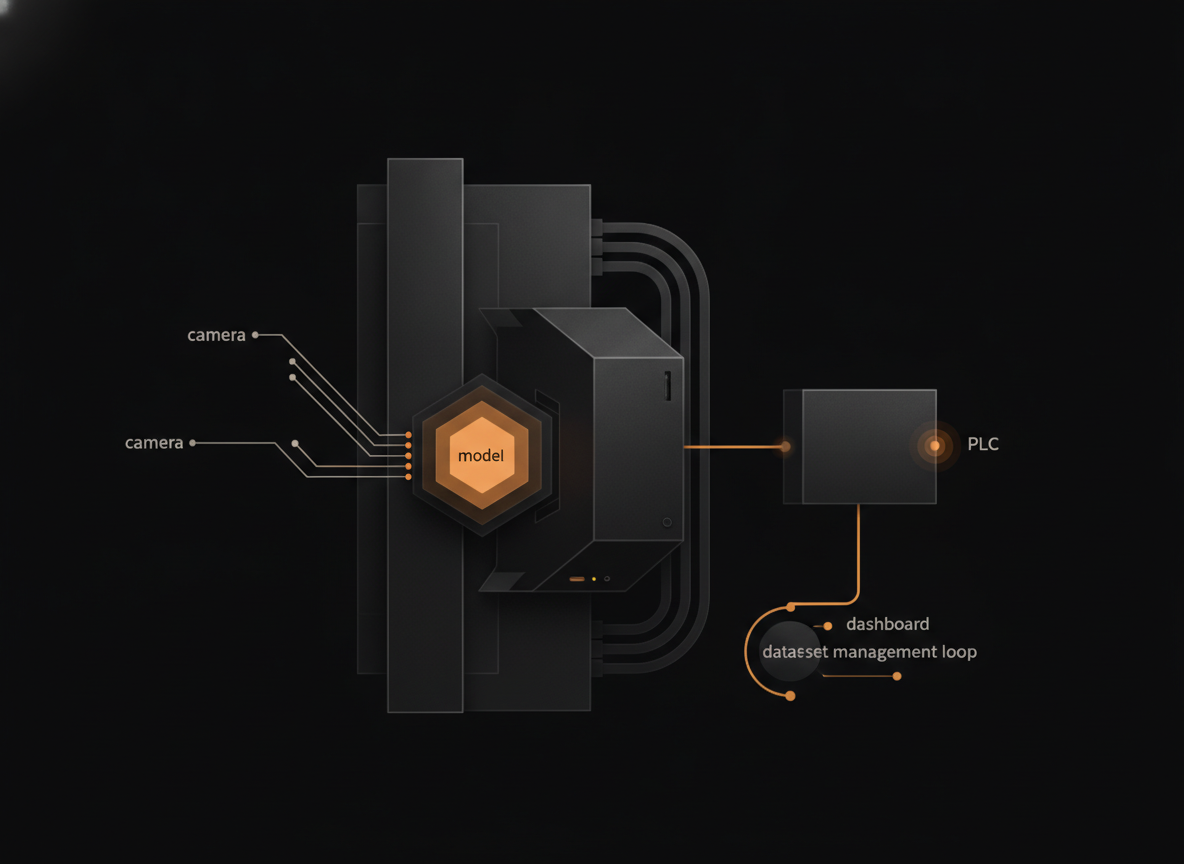
A vision system isn't an island; it's a node on a line that already has cameras, a PLC, a reject mechanism, an MES, and a quality team that owns the spec. The value shows up only when the verdict reaches those systems fast enough and reliably enough to act on — every cycle, on every shift.

We build for the line you have, not the one a vendor wishes you had. That means working with your existing cameras and controllers where we can, retrofitting where we must, and handing your team the dashboards and the audit trail a quality function and an auditor both expect.

Cameras and controllers

Industrial cameras over GigE or USB3, triggered off your encoder or a sensor, with the verdict returned to the PLC inside the cycle time the line runs at.

MES and quality records

Every verdict, image, and reason logged to your MES or quality system, so a reject is traceable to the unit, the time, and the evidence months later.

The reject and the operator

Wired to the actuator that diverts a failed part and the HMI that tells an operator why, so a rejection is actionable on the floor, not a number in a report.

Audit and traceability

A stored image and decision for every unit — which is what a recall investigation, a customer audit, or a regulator actually asks for.

Vision inspection already doing real work

Metrics shown dotted (··) are being finalised in our case-study metrics pack and published only once verified. The deployments are real.

RAK Ceramics

Computer-vision surface inspection on a live ceramics line

  • ··%surface defects caught in-line
  • ··%manual grading load removed

We put a computer-vision system on a real ceramics production line in the UAE, grading tile surface and finish at line speed and flagging defects for reject before packing. That same regional delivery base now backs vision work across the GCC.

Automotive components supplier (anonymized)

Dimensional and assembly verification on a Tier-1 line

  • ··%out-of-spec parts caught before dispatch
  • ··×faster than the manual gauge station

A vision station measures critical dimensions and verifies every component is present and seated, rejecting out-of-tolerance parts on the line instead of at a customer's incoming inspection. The verdict drives the existing PLC and reject gate.

Packaging line, food & beverage (anonymized)

Label, code, and fill verification before despatch

  • ··%mislabeled units stopped
  • ··minto flag a print fault, down from a shift

Vision reads the lot code, expiry, and barcode and checks the label matches the order, holding any unit that is mislabeled, unreadable, or short-filled. Every decision is logged with the image for traceability.

We hold a vision line to the standard we run our own AI to

Banao runs a ~300-person engineering company on its own AI in production every day. InterviewGod screens our own hires; Vikaas runs our own demand generation. Neither is a camera on a line — but both are AI that has to be right on real inputs, monitored for drift, and trusted by our own team, or it gets switched off.

That is the discipline a vision line lives or dies on: a dataset you maintain, a metric you watch, a human in the loop on the hard cases, and a retraining path for when the world changes. We bring the standard we hold our own systems to, not a first attempt paid for with your line.

  • InterviewGodAI we run on our own hiring — held to a measured bar, every week.
  • VikaasAI we run on our own demand generation, monitored in production daily.

Where we build and run vision inspection

We deliver from India, the UAE, the UK, and the US, and build to the image, footage, and data-residency rules each market and regulator expects.

GCC & UAE

Industrial diversification across the free zones is putting new lines into production, and we already run computer-vision inspection in the UAE with RAK Ceramics. Image and footage data is kept inside UAE boundaries where the PDPL and client policy require it.

Saudi Arabia

Vision 2030 and the National Industrial Development programme are standing up factories that need automated quality control from day one. We build Arabic-capable interfaces and keep inspection data in-Kingdom to meet PDPL and SDAIA expectations.

United States

Reshoring and a tight, costly labor market are pushing US manufacturers to automate inspection rather than staff a third shift of inspectors. We build to SOC 2 controls and the audit logging US quality and risk teams ask for.

United Kingdom

UK food, pharma, and precision-manufacturing lines carry strict inspection and traceability obligations. Our Cambridge presence supports that work under UK GDPR, with an image-level audit trail for every unit.

India

Our Bangalore and Chandigarh bench delivers vision systems for the country's automotive, pharma, electronics, and textile lines — close to the engineers who build them and under the DPDP Act.

When computer vision is the wrong tool for the check

Most vendors will fit a camera to any inspection problem. We would rather tell you when vision isn't the answer — it is why quality engineers take our second call.

  • The defect isn't visible to a camera: internal cracks, voids, or material flaws need X-ray, ultrasound, or eddy-current — not an ordinary image model. We will say so rather than sell you one that can't see them.
  • Too few defects to learn or to prove: if real defects are so rare you can't assemble a validation set, you can't trust a model's accuracy claim — and neither can we.
  • A cheaper sensor already solves it: a weight check, a laser gauge, or a simple proximity sensor can beat vision on cost and reliability for the right defect. We will point you to it.
  • Presentation can't be controlled: if parts arrive in random orientation under uncontrolled light and that won't change, fix the line first — a model can't out-think a bad image.
  • Volume too low to earn it: a hand-built, low-volume line where an inspector handles every unit may never repay the build, integration, and upkeep of a vision system.

How we start — prove it on your hardest defect first

You have likely been shown a vision demo that worked on someone else's parts. We start by proving feasibility on yours, not by quoting a build.

  1. AI Discovery Sprint2 weeks · fixed price

    We take samples or images of your hardest defect class, test whether a model can catch it at your tolerance, and hand back a feasibility verdict, a rig and integration plan, and ROI maths — yours to keep either way. If you proceed, the Sprint cost is credited against the build.

  2. Build and integrate

    We design the camera and lighting rig, build and label the dataset from your line, train and validate to your acceptance criteria, and wire the verdict into your PLC and reject mechanism.

  3. Production and drift monitoring

    We deploy at line speed with monitoring on detection and false-reject rate, a human-review path for low-confidence cases, and a retraining loop that keeps the system honest as your line changes.

Frequently asked questions

It is using cameras and trained models to inspect every unit on a production line for defects — surface flaws, wrong dimensions, missing parts, bad labels — and to pass or reject each one automatically, at line speed, instead of relying on human spot-checks.

On a well-presented, repetitive check a vision system is consistent in a way a human can't be across a full shift — it doesn't tire or blink. The honest comparison is two numbers: detection rate and false-reject rate. We hold the system to a written target on both, scored on your own parts, before it replaces or augments a manual station.

Fewer than people fear for many checks. For common defects a few hundred labeled examples can be enough; for rare ones we use anomaly detection trained mostly on good units, plus augmentation and an active-learning loop that keeps adding real examples from your line over time.

Yes. We run models on edge hardware next to the camera so inspection keeps pace with the line and the verdict reaches your PLC inside the cycle time, without depending on a round-trip to the cloud.

We work with your existing cameras and controllers where they are suitable and retrofit where they aren't. The verdict is wired to your PLC, reject actuator, or HMI with the response time and fail-safe behaviour the line needs, and every decision is logged to your MES or quality system.

It is strong on anything visible on the surface: scratches, cracks, chips, contamination, missing or misplaced components, wrong labels, and out-of-spec dimensions. It can't see what a camera can't — internal cracks, sub-surface voids, or material composition need X-ray, ultrasound, or other sensors, and we will tell you when that is the case.

We monitor detection rate, false-reject rate, and image quality in production and alert when they move. A new supplier, a worn tool, or a lighting change can shift the distribution; the answer is a retraining path built in from the start, not a model frozen at go-live.

A common path is a 2-week Discovery Sprint to prove feasibility, then a build and integration of roughly 8–12 weeks depending on the rig and the number of checks, then a monitored ramp. Banao's engineering bench means work starts in weeks, not months.

The Discovery Sprint is a fixed price and produces the feasibility verdict and ROI maths to size the build. Build cost depends on the camera and lighting rig, the number of defect classes, line-integration complexity, and edge hardware — all of which the Sprint pins down before you commit a budget.

Yes where you need it to. We deploy so inspection images and footage stay inside the region your policy or regulation requires — UAE, Saudi Arabia, UK, US, or India — and build the audit trail your quality and compliance teams need to sign off.

Bring the defect your line keeps shipping

Bring the check that costs you the most in returns, rework, or a third shift of inspectors. In 45 minutes we'll tell you whether computer vision can catch it — and what putting it on your line would take.

Book a 45-min scoping call