AI · Predictive analytics & forecasting

A forecast nobody acts on is just an expensive opinion

Banao builds predictive analytics and forecasting systems that are tied to a decision — how much to order, who to staff, which machine to service next week — not to a chart that looks clever in a board pack and changes nothing on Monday.

We start from the baseline you already beat or miss, prove a model earns its place against it, attach honest uncertainty to every number, and wire the output into the system that actually acts. The same discipline runs our own operation before any of it reaches you.

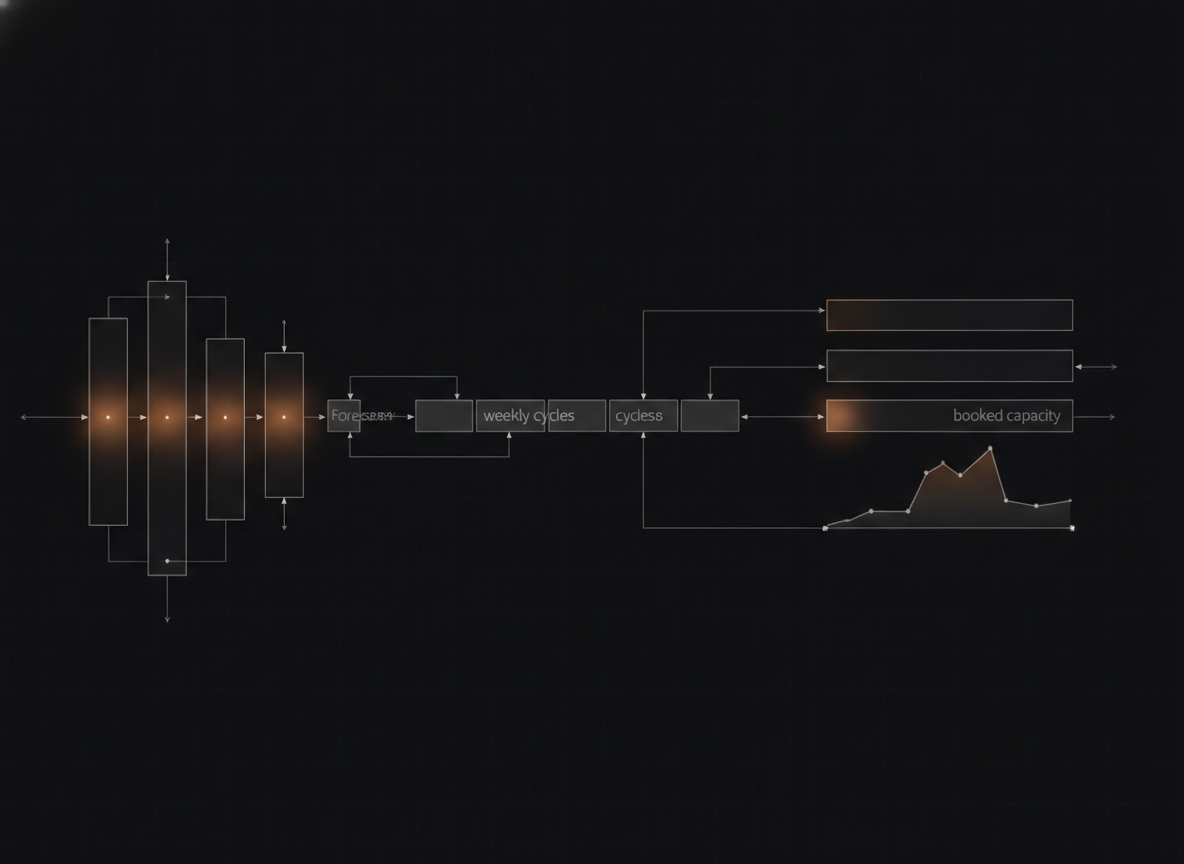
Banao— Vikaas forecasts our own sales pipeline and we book delivery capacity against it, every working week.

What we build into a forecasting system

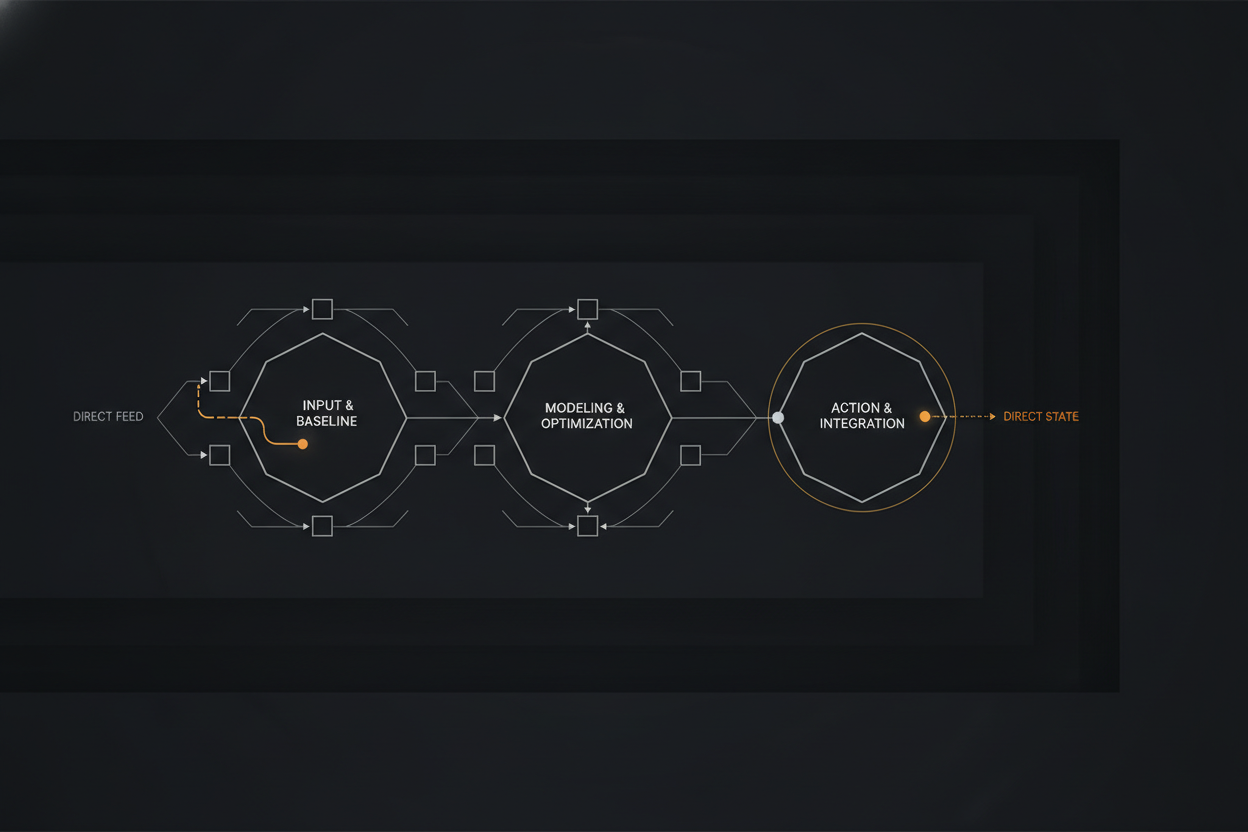
A forecast in production is not one model. It is clean inputs, a baseline to beat, a model and its uncertainty, the decision logic it feeds, and the monitoring that tells you when it has gone stale — we own all of it.

Demand & sales forecasting

SKU-, store-, and region-level demand forecasts that hold up through promotions, seasonality, and new launches — the numbers replenishment and production planning are willing to trust.

Time-series & hierarchical forecasting

Models that respect the structure of your data — daily to quarterly, item rolling up to category to total — so the figures reconcile instead of fighting each other across the planning hierarchy.

Predictive maintenance

Failure and remaining-useful-life models on sensor and telemetry data, so a service crew is scheduled before a line stops rather than after — with a clear false-alarm budget agreed up front.

Churn & retention prediction

Models that flag which customers are leaving and why, scored early enough for a retention play to matter, and aimed at the accounts where intervention actually changes the outcome.

Inventory & supply planning

We turn the forecast into the order — safety stock, reorder points, and allocation that account for lead time and forecast error, not a single number pretending to be certain.

Uncertainty & scenario modelling

Prediction intervals and scenarios, not just a point estimate, so planners size buffers against the range of outcomes and know which forecasts to trust and which to override.

Anomaly detection & early warning

Models that separate a real shift from noise in demand, revenue, or equipment behaviour, and raise a flag with enough lead time to do something about it.

Data & feature pipelines

The unglamorous 70% of the work — joining, cleaning, and back-filling messy operational data into features a model can learn from, built as a pipeline that runs every day, not a one-off notebook.

Forecast monitoring & retraining

Accuracy, bias, and drift tracked against live outcomes, with retraining triggered when the world moves — so the forecast keeps earning its place instead of quietly decaying after launch.

Decision integration

The forecast wired into your ERP, planning tool, or dashboard where the choice is actually made, with the recommended action attached — so a number becomes a decision without a human re-keying it.

How we actually build a forecast you can run a business on

Forecasting looks like a modelling problem and is mostly a data and decision problem. The model is a few weeks of the work; the inputs that feed it and the decision that consumes it are the rest. We build in that order on purpose.

We start at the end — the decision the forecast is supposed to change — and work backwards to the number, its accuracy bar, and the data it needs. A forecast with no decision attached has no way to be right or wrong that anyone cares about, so we refuse to start without one.

Baseline before model

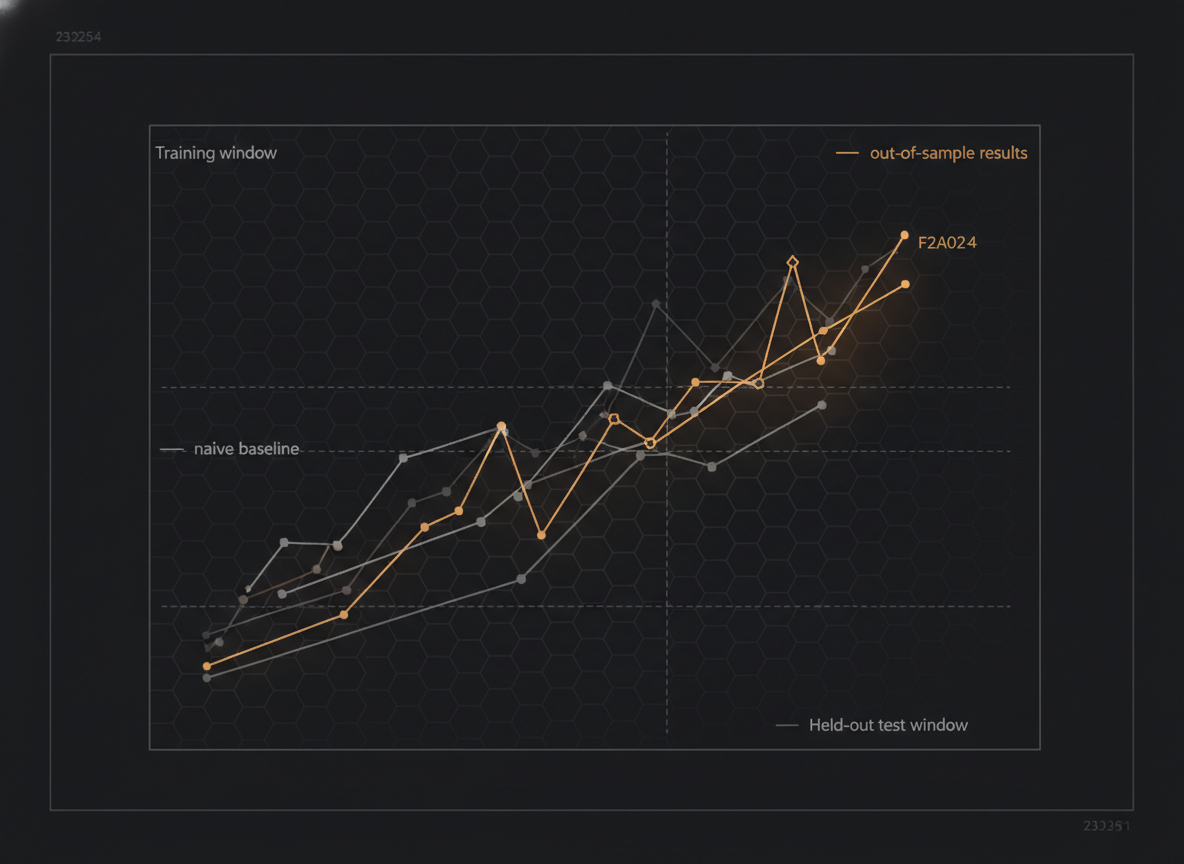
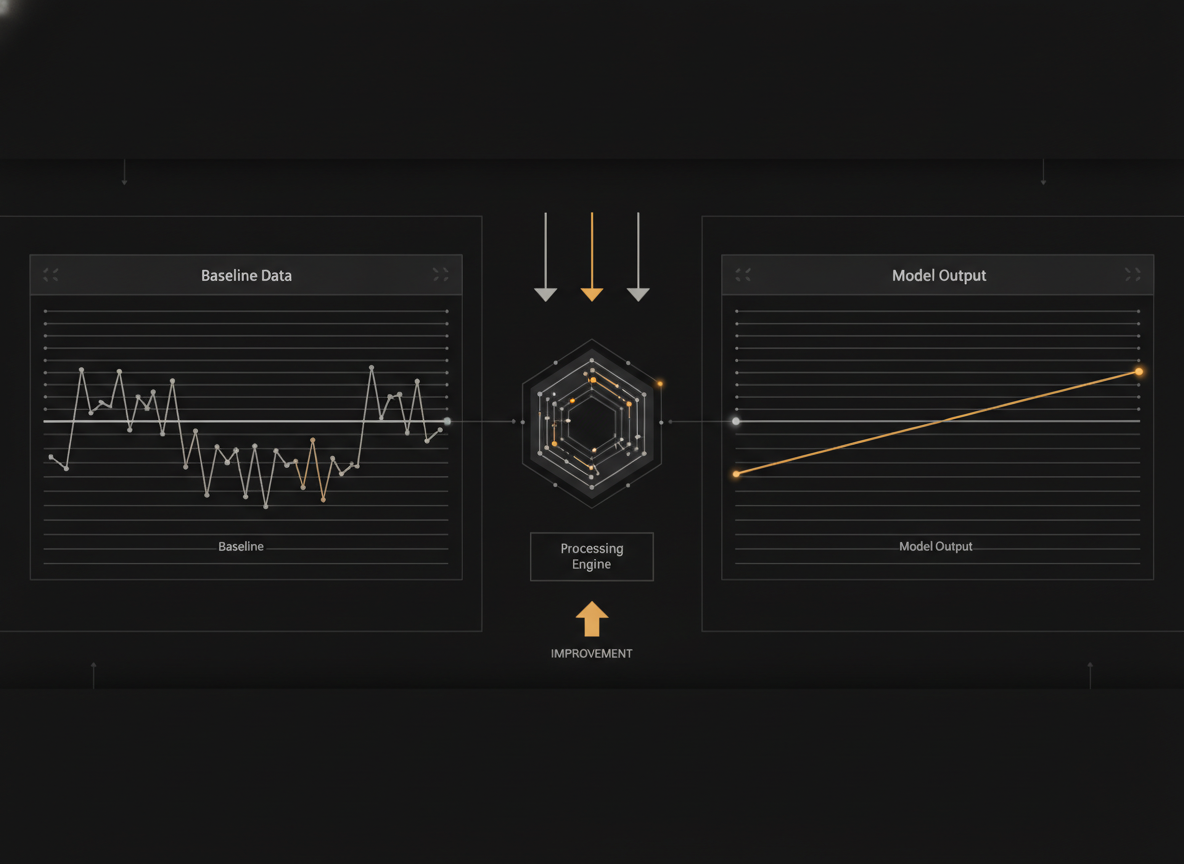
We first measure the naive forecast you implicitly run today — last year, last week, a moving average. If a model can't beat that by a margin worth the cost of operating it, we tell you, and you keep the baseline.

Backtesting on real history

Every model is tested the way it will be used — trained on the past, scored on the future it never saw, rolled forward week by week. In-sample accuracy is a vanity number; out-of-sample is the only one we report.

Uncertainty is part of the answer

We ship prediction intervals alongside the point estimate. A planner who knows a forecast is ±5% buys differently from one staring at a single confident-looking number that is quietly ±40%.

Wired into the decision

The forecast lands in the planning system, the roster, or the work order — with the recommended action attached. The deliverable is the changed decision, not a model sitting in a repository.

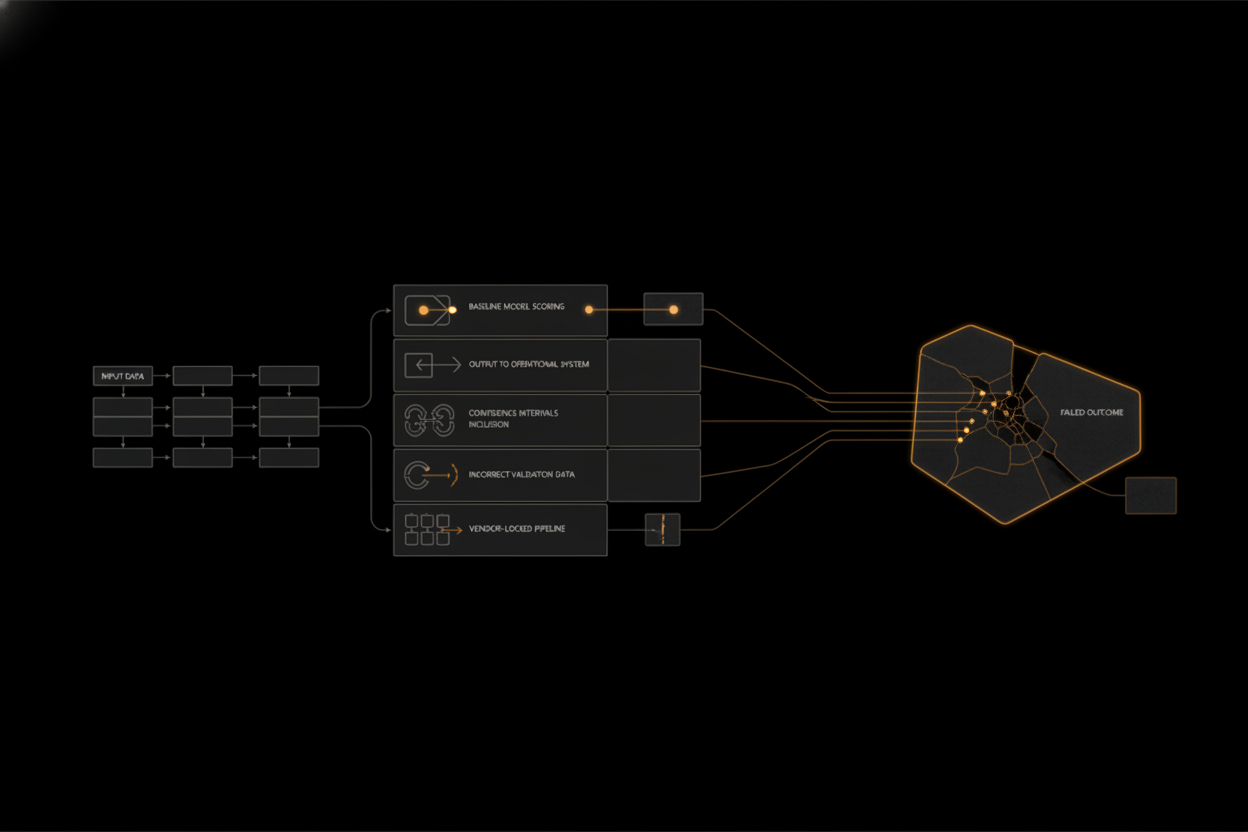
Why most predictive-analytics-forecasting projects fail

We get called in to rescue stalled forecasting projects often enough to see the same failures repeat. Almost none of them are about the model being too simple. They are about baselines, data, uncertainty, and the last mile into a decision — the engineering discipline, not the algorithm.

We would rather name these on the first call than bill you to rediscover them on the third. If your last forecasting effort never changed how anyone planned, it likely died of one of the following.

No baseline, so no honest scorecard

Teams report 92% accuracy and call it a win, never checking that last year's number alone scored 90%. Without a baseline, a model can look impressive while adding almost nothing.

Leakage that flatters the demo

A feature that quietly encodes the future makes backtests look spectacular and production results collapse. Finding and removing leakage is half of why an honest accuracy number is lower than a naive one.

A point estimate with no error bars

A single number invites false confidence. When planners can't see the uncertainty, they either over-trust the forecast or stop using it the first time it misses — and both kill the project.

No owner of the last mile

The model predicts, and then nothing happens, because no one wired it into the order, the roster, or the maintenance schedule. A forecast that doesn't reach a decision is a cost with no return.

Drift left unmonitored

Demand patterns move, a supplier changes, a new product cannibalises an old one — and an unmonitored model keeps forecasting the old world. Without drift tracking and retraining, accuracy decays in silence.

From a number to a decision — getting forecasting into production

A forecast that lives in a slide deck is harmless and useless. The value shows up only when the number changes an order quantity, a staffing roster, a maintenance window, or a retention budget — automatically, on the cadence the business runs at.

That last mile is where we spend the integration effort most projects skip. We connect the model to the operational system, encode the decision rule, and keep a human in the loop where a wrong call is expensive — so the forecast acts at the speed of the business without acting recklessly.

Into the system of record

Forecasts land in your ERP, WMS, or planning tool through their APIs — including older systems via a retrofit — so planners see them where they already work instead of in a separate report they have to remember to open.

Decision rules, not just predictions

We encode how the forecast becomes an action — reorder thresholds, staffing bands, maintenance triggers — and account for forecast error in the rule, so a noisy week doesn't whipsaw your operations.

Human override where it counts

Planners can see the forecast, the uncertainty, and the reason, and override it. Their overrides feed back as a signal we learn from, rather than a fight between the model and the people who run the floor.

Monitored against outcomes

Once live, accuracy is tracked against what actually happened, broken down by item, region, and horizon — so you know exactly where the forecast is trusted, where it isn't, and what to fix next.

Forecasting already changing real decisions

Metrics shown dotted (··) are being finalised in our case-study metrics pack — published only once verified against live outcomes. The deployments are real.

Banao — Vikaas

Pipeline forecasting we book our own capacity against

  • ··%forecast vs. actual pipeline accuracy
  • ··wkplanning horizon for delivery capacity

Vikaas forecasts Banao's own sales pipeline by stage and week, and our delivery leads staff the bench against it. When the forecast is wrong we feel it in our own utilisation first — which is exactly why we trust it before we offer the pattern to a client.

National retail group (anonymized)

Demand forecasting wired into replenishment

  • ··%reduction in stockouts
  • ··%lower excess inventory

SKU-by-store demand forecasts that account for promotions and seasonality, feeding reorder points and allocation directly. Planners override where they have ground truth the model lacks, and those overrides train the next version rather than getting lost in a spreadsheet.

Industrial manufacturer (anonymized)

Predictive maintenance on production-line telemetry

  • ··%unplanned downtime avoided
  • ··hrsearlier failure warning

Remaining-useful-life models on sensor data flag at-risk equipment with enough lead time to schedule a service crew before a line stops. The false-alarm budget was agreed with the plant team up front, so the alerts are trusted instead of muted.

We forecast our own business before we forecast yours

Banao runs a ~300-person engineering company on its own predictive systems before any client sees them. Vikaas forecasts our sales pipeline and we book delivery capacity against it; we forecast bench utilisation and hiring demand the same way. When a forecast is wrong, it is our own quarter that pays for it.

That is the difference between a vendor who has modelled someone else's data once and one whose own planning depends on getting this right every week. By the time a forecasting system reaches your operation, it has already had to survive ours.

  • VikaasForecasts Banao's own demand-gen pipeline, which our delivery planning is staffed against.
  • InterviewGodPredicts hiring throughput from our own application funnel, so the bench is sized ahead of demand.

Where we build and deploy forecasting

We deliver from offices in India, the UAE, the UK, and the US, and we build to the data-residency and governance rules each market expects of a system that drives operational decisions.

GCC & UAE

Retail and logistics demand in the UAE swings hard around Ramadan, Eid, and the tourism calendar, and free-zone supply chains feel every miss. From Dubai we build seasonal demand and inventory forecasts — including long-standing work with RAK Ceramics — and keep data inside UAE boundaries where the PDPL and client policy require it.

Saudi Arabia

Vision 2030 industrial and giga-project programmes need demand, energy, and maintenance forecasting at a scale the Kingdom hasn't run before. We build Arabic-aware analytics and keep data in-Kingdom to meet PDPL and SDAIA expectations for regulated and critical-infrastructure workloads.

United States

Reshoring and high labour costs make workforce and demand forecasting a margin question for US enterprises. For California and New York operations we build to SOC 2 controls, with the model documentation, validation, and audit trail that procurement and risk teams ask of any model that moves money.

United Kingdom

From Cambridge we support retail, energy, and financial-services forecasting under UK GDPR and FCA expectations, where a model that drives a regulated decision has to be explainable and its accuracy auditable, not a black box no one can defend.

India

Bangalore and Chandigarh hold our delivery bench, so a forecasting build starts in weeks. We have built for the demand volatility of Indian retail and quick-commerce, design to the DPDP Act, and run cost-efficient delivery close to the engineering that ships it.

When forecasting is the wrong tool

Most vendors will model anything you hand them. We would rather tell you when a forecast won't pay for itself — it is why planning teams take our second call.

  • No decision attached: if no one will change an order, a roster, or a schedule because of the number, a forecast is a report, and a report is cheaper to write by hand.
  • Too little history or pure novelty: a brand-new product, a one-off event, or a market with no analog gives a model nothing to learn from — judgement and scenarios beat a false-precision forecast.
  • The naive baseline is already good enough: if last week or last year predicts well enough for the decision at hand, the right answer is to keep it and spend the budget elsewhere.
  • Acting on the forecast costs more than the error: if the operational change a forecast would drive is expensive or slow to reverse, the value has to clear that bar before a model is worth building.

How we start — prove the forecast before you build it

You have likely seen forecasting pitches that lead with accuracy numbers and no baseline. We start by proving a model beats what you already run, on your own data, before quoting a build.

  1. AI Discovery Sprint2 weeks · fixed price

    We take your real history, establish the naive baseline, backtest a model against it on the decision that matters, and hand back the measured accuracy lift, an honest feasibility read, and the ROI maths — yours to keep either way. If you proceed, the Sprint cost is credited against the build.

  2. Build

    We build the data pipelines, the model and its uncertainty, the decision logic, and the integration into your planning system together — the last mile into a decision is a deliverable, not an afterthought.

  3. Production & continuous learning

    We deploy with accuracy, bias, and drift monitored against live outcomes, retrain when the world moves, and keep the forecast earning its place — feeding planner overrides back in as signal rather than fighting them.

Frequently asked questions

Forecasting predicts a quantity over time — demand next quarter, failures next week. Predictive analytics is the broader practice of using historical data to predict an outcome, including churn, risk, and anomalies. We build both, and in either case we tie the prediction to a decision it is meant to change rather than a dashboard.

The honest answer is: more accurate than the baseline you run today, by a margin we measure before you commit. We backtest on your real history — training on the past and scoring on the future the model never saw — and report that out-of-sample number, not a flattering in-sample one. We also report the uncertainty, so you know how much to trust each forecast.

Enough to cover the patterns you want to predict — usually two or more cycles of the seasonality that matters, so a couple of years for annual seasonality, less for short-horizon operational forecasts. If the history is thin or messy, the Discovery Sprint is where we find that out cheaply, before a build, rather than after.

No — it is the normal starting point, and most of the work. We handle the joining, cleaning, and back-filling as part of the build and turn it into a pipeline that runs every day. You do not need a finished data warehouse before you start; we build the inputs the forecast needs as we go.

Dashboards tell you what already happened. Forecasting tells you what is likely to happen next and, in our builds, what to do about it — the reorder, the roster, the service window. We can feed your existing BI tool, but the value is the decision the number drives, not another chart to read.

We monitor accuracy, bias, and drift against live outcomes and trigger retraining when the world moves — a new product, a supplier change, a demand shift. Drift is treated as a first-class part of the system, not a surprise you discover months later when planners have quietly stopped trusting the forecast.

A common path is a 2-week Discovery Sprint, a 6–10 week build, and a staged rollout that starts alongside your current planning before it replaces it. Banao's ~300-engineer bench means delivery begins in weeks, not the months a fresh hire would take.

That is what the AI Discovery Sprint produces — fixed price, two weeks, the measured accuracy lift over your baseline and an ROI model you keep whether or not you continue. Worst case you have an honest read on feasibility; best case you have the business case for your board.

Yes. We deploy to your cloud and keep data inside the region your policy or regulation requires — UAE, Saudi Arabia, UK, US, or India — and build the model documentation and audit logging your risk team needs to sign off on a model that drives operational decisions.

That is the point of the build. We wire the forecast into your ERP, WMS, or planning tool through their APIs — including older systems via a retrofit — with the recommended action attached, so the number reaches the decision without anyone re-keying it. Integration is part of the deliverable, not a separate project.

Find the forecast that would change a decision you make every week

Bring the plan you redo by hand every cycle — the order, the roster, the maintenance schedule. In 45 minutes we'll tell you whether a forecast can beat how you do it today, and what it would take to put one in production.

Book a 45-min scoping call