AI · Document intelligence automation

Document intelligence that reads the messy, real-world paperwork plain OCR keeps getting wrong

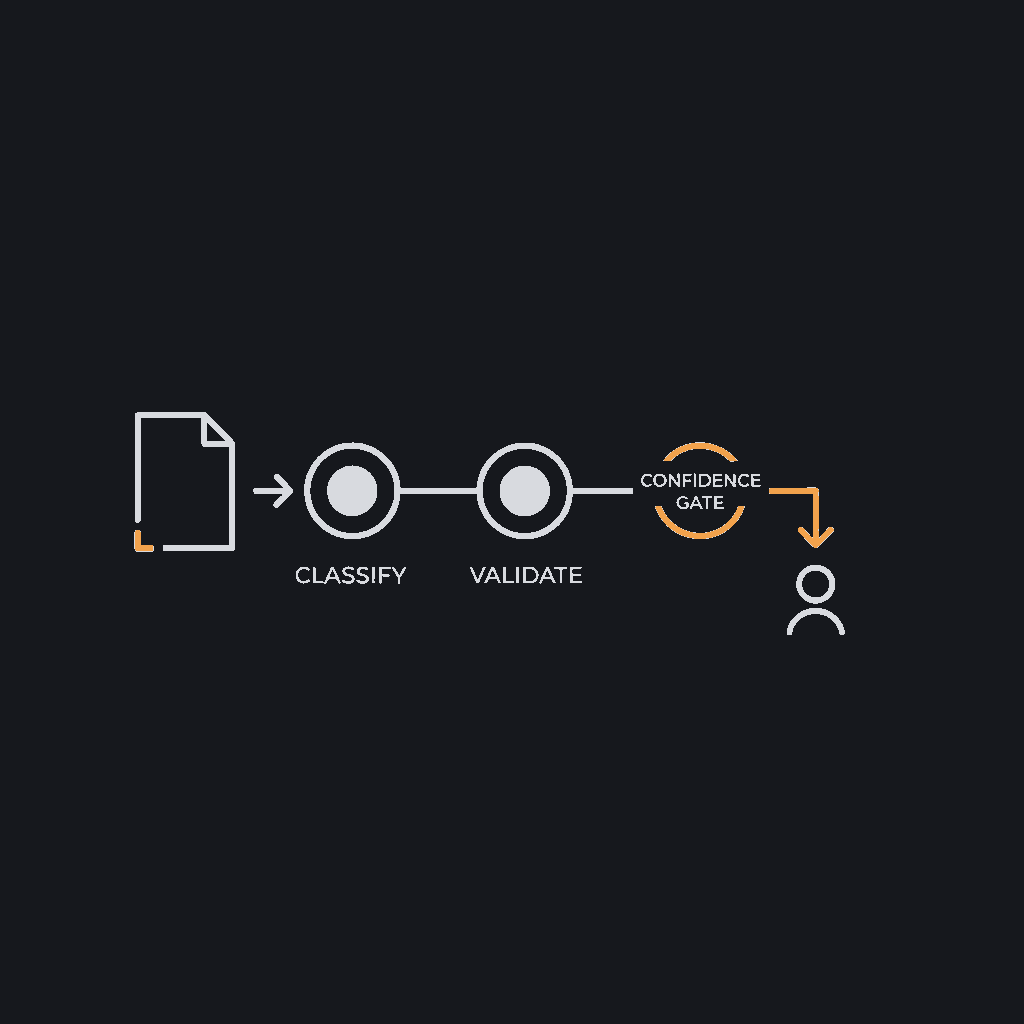
Banao builds document intelligence automation that ingests your invoices, contracts, forms, IDs, and statements, extracts the fields that matter, validates them against your systems of record, and routes the result into your ERP, core banking, or claims platform — with a person checking only the cases the model is unsure about.

We deliver the whole pipeline, not a model demo: classification, extraction, validation, exception handling, and the confidence thresholds that decide what a human ever sees. It is built to the production standard we hold the AI that runs our own company to.

Digital lender (anonymized)— KYC and income documents classified and extracted inside onboarding, before a reviewer opens the file.

What we build into a document intelligence pipeline

A document pipeline in production is not one OCR call. It is classification, extraction, validation against your data, a confidence threshold, an exception queue, and the integration that posts the result — we own all of it.

Document classification and splitting

Sorting a mixed batch into the right document types and splitting a 40-page PDF into the invoice, the contract, and the ID it actually contains — before a single field is read.

Key-field and line-item extraction

Pulling header fields, totals, and nested line-item tables from invoices, purchase orders, and statements — the part where a fixed template breaks on the next vendor's layout.

Layout-aware reading of unstructured documents

Reading documents that arrive in any layout, as scans, phone photos, or generated PDFs, without a hand-built template per sender — the case that defeats classic OCR rules.

Validation against your systems of record

Checking each extracted value against your master data and business rules — vendor exists, PO matches, totals add up — so the pipeline catches a wrong number, not just a low-confidence one.

Confidence scoring and exception routing

Every field carries a confidence score. The clear documents process straight through; only the uncertain ones reach a reviewer, so people spend their time where judgement is actually needed.

ID and KYC document verification

Reading passports, national IDs, and proofs of address, cross-checking the data for consistency and expiry, and flagging tampering and mismatch signals for a human to adjudicate.

Contract and clause extraction

Surfacing parties, dates, values, renewal and termination clauses, and obligations across a contract set, so legal and procurement review the terms instead of hunting for them.

Handwriting, stamps, and signature handling

The parts plain OCR drops: handwritten amounts on a form, a stamp that proves approval, a signature block that decides whether a document is complete.

Straight-through processing and integration

Posting the validated result into your ERP, core banking, claims, or RPA bot through its API, so an approved document moves the process forward without a person retyping it.

Audit trail, retention, and monitoring

Every extraction stored with the source image and the confidence behind it, plus dashboards on accuracy and straight-through rate — what an auditor asks for and what tells you when accuracy slips.

How we build document intelligence that survives real-world documents

A document-extraction demo runs on a clean, machine-generated invoice in one consistent layout. The work arrives as a phone photo of a crumpled receipt, a 30-year-old contract scanned at an angle, a form filled in by hand, and the same supplier's invoice redesigned last quarter. Almost all of the engineering is in closing that gap, and very little of it is the model reading the text.

We start with classification, not extraction. We sort and split the batch, pull fields with a layout-aware model rather than a per-sender template, validate every value against your own data, and route only the low-confidence cases to a person. The model that reads the characters is a few weeks; the classification, the validation rules, and the exception workflow are the project.

Classify before you extract

Knowing what a document is — and splitting a bundle into its real parts — is half the accuracy. Extraction tuned for an invoice applied to a delivery note is where silent errors begin.

Validate, don't just extract

Reading a total is not enough; the total has to be right. We check extracted values against your master data and arithmetic, so a confidently-wrong number is caught instead of posted.

The confidence threshold is the product

The dial between automation and risk is the confidence cut-off. We tune it to your real cost of a missed error versus a needless review, not to a demo that looked impressive once.

Built on your documents, not a benchmark

Public datasets don't contain your vendors, forms, or handwriting. We build a labelled ground-truth set from your own documents and measure accuracy against it, not against a published score.

Why most document-automation projects stall at 80% and never finish

We get called in to restart document projects that hit 80% accuracy in a pilot and then never reached the volume that justified them. The model is almost never the reason. The pilot ran on the clean documents, the exceptions had nowhere to go, and the straight-through rate — the number that actually pays for the project — was never measured.

We would rather name these on the first call than bill you to rediscover them. If your last document-automation pilot didn't make it into production, it likely died of one of the following.

The 80/20 trap

Reaching 80% on the easy documents is quick; the value lives in the last 20% — the exceptions, the bad scans, the new layouts. A pipeline with no plan for those keeps a human in the loop on everything.

Templates that break on the next vendor

A per-sender template parser works until a supplier moves a field or a new vendor arrives, then it fails silently. Maintaining hundreds of templates becomes its own full-time job nobody scoped.

Accuracy measured on the easy documents

An accuracy figure quoted on hand-picked, well-scanned documents proves nothing about the real intake. The honest metric is the straight-through rate on a representative sample of what actually arrives.

No home for the exceptions

When a document is unclear, someone has to resolve it. Without a reviewer queue people will use, the uncertain documents pile up, trust erodes, and the team quietly goes back to keying everything.

From a pile of documents to straight-through processing

A document pipeline isn't an island. It sits in front of an ERP, a core banking platform, a claims or loan-origination system, and a team that owns the process and the audit. The value shows up only when a validated document moves that process forward on its own — and when the cases that can't are handed to a person cleanly, with the evidence attached.

We build for the systems you already run, not the ones a vendor wishes you had. That means validating against your master data, posting through real APIs, sitting beside your RPA where one already exists, and handing your team the reviewer queue and the audit trail that a process owner and an auditor both expect.

Into the system of record

Validated data is posted into your ERP, core banking, or claims platform through its API, so an approved invoice or application advances without a person retyping a field.

Beside your RPA, not instead of it

Where you already run RPA, document intelligence becomes the part that reads and decides, handing structured, validated data to the bot that does the clicking — fixing the brittle OCR step that breaks most bots.

A reviewer queue people actually use

Exceptions land in a queue that shows the document, the extracted fields, and the reason for the flag side by side, so a reviewer corrects one case in seconds instead of re-reading the whole document.

Audit and retention by design

Every document, field, confidence score, and decision is logged with the source image, so a dispute, an audit, or a regulator can be answered months later from the record, not from memory.

Document pipelines already doing real work

Metrics shown dotted (··) are being finalised in our case-study metrics pack and published only once verified. The deployments are real.

Digital lending platform (anonymized)

KYC and income documents read inside customer onboarding

  • ··%applications auto-cleared without manual review
  • ··hrsreview time removed per 1,000 applications

An onboarding pipeline classifies each uploaded document, extracts identity and income fields, cross-checks them for consistency, and clears the clean applications straight through — sending only the flagged, mismatched, or low-confidence cases to a reviewer.

Insurance carrier (anonymized)

Claims intake that reads the FNOL pack on arrival

  • ··%claim documents auto-classified and extracted
  • ··daysoff the claim-registration cycle

A first-notice-of-loss pack arrives as a mix of forms, photos, and PDFs. The pipeline splits it, classifies each part, extracts the policy and loss details, and registers the claim, holding the ambiguous documents for an adjuster instead of stalling the whole submission.

Shared-services finance team (anonymized)

Accounts-payable invoices read, matched, and posted

  • ··%invoices straight-through to the ERP
  • ··hrsof manual keying removed each month

Supplier invoices in dozens of layouts are read, the line items extracted, and each one matched against its purchase order and goods receipt before posting to the ERP. Mismatches and new vendors route to AP; everything that reconciles posts on its own.

Our own hiring runs on a document-intelligence problem

Banao operates a ~300-person engineering company on its own AI in production every day. InterviewGod reads and screens our inbound applications — CVs in every format, layout, and language — before a recruiter opens the pile; Vikaas runs our own demand generation. Both are AI that has to be right on messy, real-world inputs, or we feel it ourselves.

Reading a CV is a document-intelligence problem in miniature: varied layouts, missing fields, the same fact written ten different ways. The discipline that keeps InterviewGod honest — a ground-truth set, a confidence threshold, and a human on the cases it isn't sure about — is the discipline we bring to your invoices, contracts, and forms.

  • InterviewGodReads and ranks Banao's own inbound CVs before a recruiter opens the pile, every week.
  • VikaasRuns Banao's own demand-gen pipeline end to end, in production daily.

Where we build and run document intelligence

We deliver from India, the UAE, the UK, and the US, and build to the language, e-invoicing, and data-residency rules each market and regulator expects.

GCC & UAE

Government and trade digitization across the UAE runs on documents — trade licences, customs paperwork, and contracts in Arabic and English. We build bilingual extraction and keep document data inside UAE boundaries where the PDPL and client policy require it, from a delivery base that already serves the region.

Saudi Arabia

ZATCA's e-invoicing mandate and Vision 2030's digital-government push have made structured document data a compliance requirement, not a nice-to-have. We build Arabic-first extraction and keep document data in-Kingdom to meet PDPL and SDAIA expectations for regulated workloads.

United States

A tight, costly labor market is pushing US finance, mortgage, and insurance teams to automate document-heavy back offices rather than staff them. We build to SOC 2 controls with the audit logging US procurement and risk teams ask of any system that posts to a system of record.

United Kingdom

UK financial services and the public sector carry strict KYC, AML, and records obligations on the documents they process. Our Cambridge presence supports that work under UK GDPR and ICO guidance, with a field-level audit trail for every document.

India

The country's digital-KYC and account-aggregator ecosystem makes document automation core to onboarding at volume, often across many languages. Our Bangalore and Chandigarh bench delivers close to the engineers who build it, under the DPDP Act.

When document intelligence is the wrong tool

Most vendors will fit a document model to any pile of paper. We would rather tell you when not to build one — it is why finance and operations teams take our second call.

  • The data already exists in structured form: if a document is really a PDF of data you can get as a feed, file, or API, ingest the source directly — don't OCR a picture of data you already have cleanly.
  • One layout that never changes: if every document is the identical template from a single source, a deterministic parser is cheaper and more reliable than a model deciding the obvious.
  • Volume too low to earn it: if a document type arrives a handful of times a week, a person is cheaper than building, validating, and operating a pipeline for it.
  • Zero tolerance for error with no review queue: if a single wrong field is catastrophic and you won't staff an exception review, full automation is the wrong shape — keep the human gate.
  • The decision must be made by a person: where law or policy requires a human to approve, the pipeline should extract and prepare, not decide. We will build it to assist the reviewer, not replace them.

How we start — prove the straight-through rate before you build

You have likely been shown a document demo that worked on someone else's clean invoices. We start by measuring what is achievable on yours, not by quoting a build.

  1. AI Discovery Sprint2 weeks · fixed price

    We take a real sample of your hardest document type, measure the extraction accuracy and straight-through rate achievable at your tolerance, and hand back a pipeline design, an exception-workflow plan, and ROI maths — yours to keep either way. If you proceed, the Sprint cost is credited against the build.

  2. Build and integrate

    We build classification, extraction, the validation rules against your data, the confidence thresholds, and the reviewer queue, then wire the validated output into your ERP, core banking, claims, or RPA.

  3. Production and continuous improvement

    We deploy with monitoring on accuracy and straight-through rate, a human-review loop on the exceptions, and a path to improve the models as new document types, vendors, and layouts arrive.

Frequently asked questions

It is using AI to turn unstructured documents — invoices, contracts, forms, IDs, statements — into structured, validated data and to route that data into your systems automatically. A pipeline classifies each document, extracts the fields, checks them against your own data, and sends only the uncertain cases to a person.

OCR converts an image to text; it doesn't understand the document. Document intelligence adds the parts that make text useful: knowing what the document is, finding the right fields across any layout, validating them against your records, scoring confidence, and handing exceptions to a reviewer. OCR is one component inside the pipeline, not the pipeline.

Invoices and purchase orders, contracts, KYC and ID documents, application and claim forms, bank and financial statements, delivery notes, and mixed bundles of all of the above. If your team currently reads and retypes a document type by hand, it is usually a candidate — we measure feasibility on your real samples in the Discovery Sprint.

Accuracy depends on the document and the field, so we measure two numbers on your own documents: field-level accuracy and the straight-through rate — the share that needs no human touch. We build a ground-truth set from your documents and tune the confidence threshold so the clear cases auto-process and the uncertain ones go to review, instead of quoting a single headline figure.

Yes, by design. The goal is not to remove every person; it is to stop having a person read the clear documents. A reviewer handles only the low-confidence and exception cases, with the document and the flagged fields in front of them, so the same team processes far more volume without rubber-stamping work the model can't be trusted on.

To a degree, and honestly about the limits. Modern models handle a lot of handwriting, stamps, and low-quality scans that classic OCR drops, but a fully illegible field should fail to a human, not be guessed. We route low-confidence reads to review rather than letting the pipeline invent a value it can't actually see.

Yes — that is the point of the pipeline. We post validated data into your ERP, core banking, loan-origination, or claims platform through its API, including older systems via retrofit, and we sit beside your RPA where one already exists. Integration is part of the build deliverable, not a separate project.

Yes. We build extraction for Arabic and English and other languages your intake requires, which matters for GCC government, trade, and onboarding documents and for multilingual operations in India. Bilingual handling is designed in from the start rather than bolted on later.

A common path is a 2-week Discovery Sprint to prove the achievable straight-through rate, then a build and integration of roughly 6–10 weeks depending on the document types and the number of target systems, then a monitored ramp. Banao's engineering bench means work starts in weeks, not months.

Yes where you need it to. We deploy so document data stays inside the region your policy or regulation requires — UAE, Saudi Arabia, UK, US, or India — and build the field-level audit trail and retention your compliance and risk teams need to sign off.

Bring the document type that eats the most hours

Bring the invoice, claim, or onboarding pack your team still keys by hand. In 45 minutes we'll tell you how much of it can run straight through — and what putting that pipeline into production would take.

Book a 45-min scoping call