Published May 10, 2026
AI SaaS Development: How Intelligent SaaS Platforms Are Redefining Modern Software Businesses
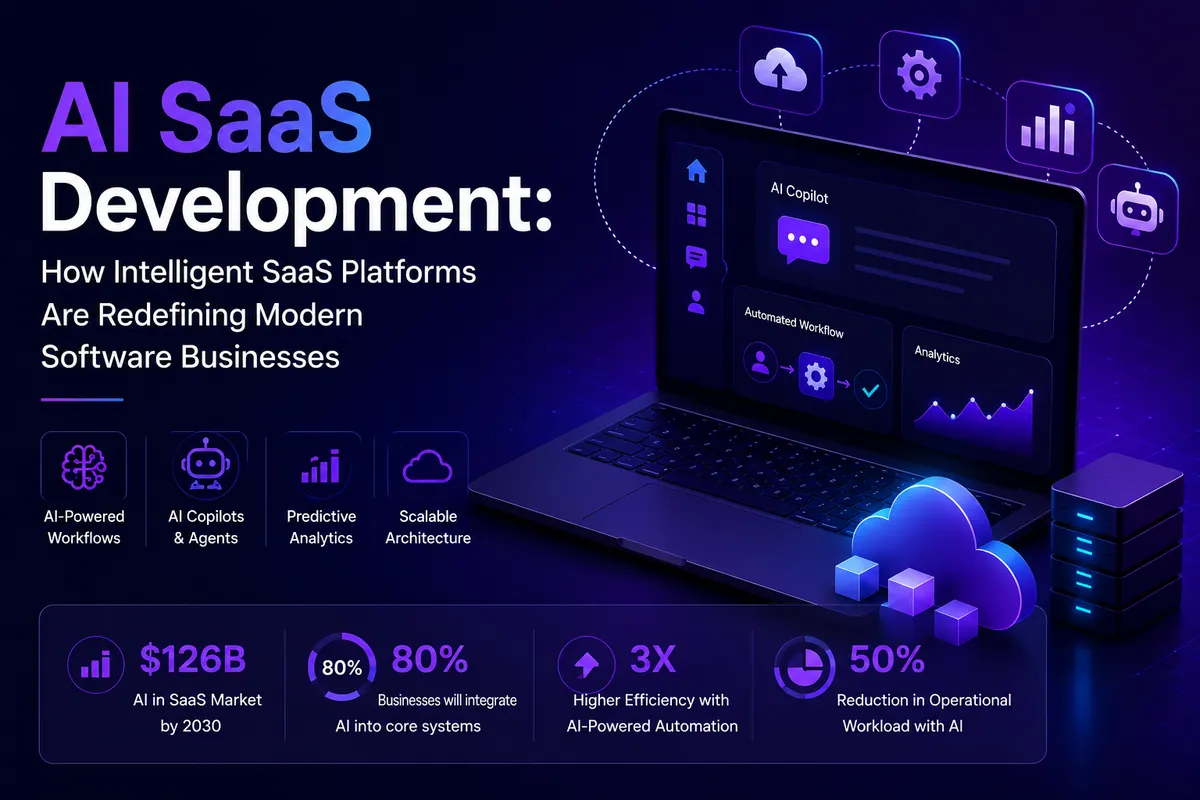
AI SaaS Development: How Intelligent SaaS Platforms Are Redefining Modern Software Businesses
Traditional SaaS products are no longer enough to sustain competitive growth.
For years, SaaS companies competed through:
feature expansion
integrations
pricing models
UI improvements
But the market has changed rapidly.
Today, businesses expect software to:
automate workflows
improve decision-making
personalize user experiences
reduce operational friction
deliver intelligent recommendations
This shift is exactly why AI SaaS development is becoming one of the fastest-growing segments in modern software infrastructure.
Businesses are no longer asking:
“Should our SaaS platform use AI?”
They are asking:
“How quickly can we build intelligent SaaS products that improve efficiency, user engagement, and scalability?”
This is where Banao Technologies positions itself differently.
Instead of functioning like a traditional software development company, Banao works as an AI product engineering partner that helps startups and SaaS businesses:
build AI-native SaaS platforms
integrate intelligent workflows
develop scalable AI architectures
launch AI-powered MVPs
implement AI copilots and automation systems
scale SaaS infrastructure efficiently
Because modern SaaS competition is no longer driven only by software features.
It is increasingly driven by software intelligence.
Why AI SaaS Development Is Growing Rapidly
The SaaS market is undergoing a major transformation.
AI adoption across software ecosystems is accelerating because businesses now expect products to deliver more than static workflows.
According to Microsoft’s Work Trend Index, organizations globally are increasingly adopting AI-powered systems to improve productivity, automate repetitive work, and enhance operational efficiency across digital platforms.
intelligent automation
predictive analytics
workflow optimization
operational scalability
This shift is happening because traditional SaaS systems often struggle with:
repetitive workflows
weak personalization
manual operational dependency
inefficient reporting
limited automation capabilities
Modern users expect software to:
think intelligently
automate repetitive tasks
generate recommendations
improve workflows automatically
reduce manual effort
Modern SaaS products are no longer competing only on features. They are competing on intelligence.
What Is AI SaaS Development?
AI SaaS development refers to building cloud-based software platforms that integrate artificial intelligence into core workflows and product experiences.
Unlike traditional SaaS systems, AI-powered SaaS platforms are designed to:
learn from user behavior
automate operational workflows
generate insights
personalize user journeys
optimize business processes
improve decision-making
These platforms often include:
AI copilots
recommendation engines
predictive analytics
intelligent search
workflow automation
conversational interfaces
AI agents
real-time analytics systems
This is why AI SaaS adoption is growing rapidly across:
fintech
healthcare
e-commerce
logistics
HR tech
productivity platforms
enterprise software ecosystems
The Biggest Shift Happening in SaaS
Traditional SaaS products were built primarily to:
organize workflows
store information
centralize operations
improve accessibility
AI-native SaaS products now go far beyond that.
Modern platforms increasingly focus on:
intelligent execution
predictive systems
workflow automation
contextual recommendations
operational optimization
This changes the role of software entirely.
Instead of functioning as passive systems,
AI SaaS platforms increasingly act as:
intelligent assistants
workflow copilots
operational coordinators
predictive engines
This is creating a major competitive shift across SaaS markets globally.
Why Traditional SaaS Products Struggle Today
Many SaaS companies are struggling with:
declining engagement
weak differentiation
manual operational overhead
poor personalization
fragmented workflows
inefficient onboarding experiences
As AI-native competitors enter the market, traditional SaaS products increasingly face retention and scalability challenges. Research from MIT Sloan on AI-driven operational efficiency also highlights how AI-powered systems are helping businesses improve productivity, workflow speed, and operational scalability..
This is especially visible in:
CRM platforms
support systems
HR software
workflow management platforms
analytics systems
productivity tools
The future of SaaS is shifting from software access to intelligent software execution.
The Core Architecture Behind AI SaaS Platforms
One of the biggest misconceptions about AI SaaS development is that integrating AI APIs alone creates intelligent products.
In reality, scalable AI SaaS products require strong engineering architecture.
Modern AI SaaS systems are usually built around:
multi-tenant cloud infrastructure
scalable backend systems
AI orchestration layers
workflow automation engines
vector databases
real-time processing pipelines
role-based security systems
analytics infrastructure
This architecture allows platforms to:
scale efficiently
process large datasets
support intelligent workflows
maintain performance under growth
Without proper architecture planning, AI SaaS systems often struggle with:
unstable scaling
rising infrastructure costs
fragmented integrations
poor AI response performance
operational inefficiencies
This is why technical planning becomes critical during early-stage AI SaaS development.
The Rise of AI Copilots & AI Agents
One of the biggest trends shaping AI SaaS development today is the rise of:
AI copilots
autonomous AI agents
intelligent workflow assistants
These systems are transforming how users interact with software.
Instead of manually navigating workflows, users increasingly interact through:
conversational interfaces
intelligent prompts
automated actions
predictive recommendations
AI-generated workflows
For example:
AI copilots summarize dashboards automatically
AI assistants automate repetitive admin tasks
AI agents execute operational workflows independently
AI recommendation systems personalize user experiences dynamically
This dramatically improves:
productivity
execution speed
operational scalability
customer engagement
According to enterprise AI adoption studies, businesses implementing intelligent automation systems are increasingly prioritizing workflow intelligence over static feature expansion.
The AI SaaS Development Lifecycle
Successful AI SaaS products rarely emerge from random feature experimentation.
Strong products usually follow a structured execution lifecycle.
1. Problem Validation
Before building AI functionality, businesses must validate:
operational inefficiencies
workflow bottlenecks
repetitive user tasks
automation opportunities
Strong AI products solve high-frequency operational problems.
2. MVP Development
The goal is not building massive AI systems immediately.
The goal is:
validating workflows
testing AI usability
measuring engagement
identifying operational value early
This reduces unnecessary development costs significantly.
3. AI Integration
At this stage, businesses integrate:
LLMs
AI APIs
recommendation engines
workflow automation systems
predictive models
conversational AI
The focus remains on practical business outcomes instead of AI hype.
4. Scalability & Optimization
As adoption grows, businesses optimize:
infrastructure
AI response speed
orchestration systems
workflow performance
operational reliability
security architecture
This stage determines long-term SaaS scalability.
Why Businesses Need AI Product Engineering Partners
Many companies struggle with AI implementation because AI SaaS development requires both:
product strategy
engineering scalability
The challenge is no longer:
“Can we integrate AI?”
The real challenge is:
“Can we build scalable AI-powered products that create long-term business value?”
This is where Banao Technologies helps businesses approach AI SaaS development strategically.
Instead of focusing only on software execution, Banao helps companies:
design scalable AI architectures
simplify AI implementation
build intelligent workflows
integrate AI systems securely
optimize SaaS scalability
accelerate AI MVP launches
develop AI-native product experiences
Because successful AI SaaS products are not built by adding random AI features.
They are built through structured product thinking, scalable engineering, and intelligent workflow design.
Why AI SaaS Is Becoming a Competitive Necessity
The SaaS market is becoming increasingly crowded.
Products with similar features are everywhere.
What increasingly separates category leaders is:
intelligent automation
predictive workflows
personalized user experiences
workflow intelligence
operational efficiency
AI-driven decision systems
Businesses adopting AI SaaS systems early are creating advantages in:
retention
operational scalability
customer engagement
workflow efficiency
revenue expansion
AI-native SaaS products are not simply improving software. They are redefining how modern software businesses operate.
Final Thought
AI SaaS development is no longer a future trend.
It is becoming the next evolution of software infrastructure.
Businesses that continue treating AI as a small feature addition may struggle to compete against platforms built around intelligent workflows from the beginning.
The strongest SaaS products in the coming years will likely be those that:
automate intelligently
personalize deeply
reduce operational friction
improve continuously through AI systems
scale through intelligent architecture
Because modern users no longer expect software to simply function.
They expect software to:
assist
automate
optimize
predict
improve workflows continuously
And that is exactly why AI SaaS development is becoming one of the most important opportunities in modern digital product ecosystems.
FAQs
What is AI SaaS development?
AI SaaS development involves building cloud-based software products that integrate artificial intelligence into workflows, automation, analytics, personalization, and decision-making systems.
Why are SaaS companies adopting AI rapidly?
SaaS businesses are adopting AI to improve automation, increase user engagement, reduce operational friction, and create competitive product differentiation.
What technologies are commonly used in AI SaaS platforms?
AI SaaS products commonly use LLMs, workflow automation systems, vector databases, predictive analytics, AI copilots, recommendation engines, and scalable cloud infrastructure.
What is the difference between traditional SaaS and AI SaaS?
Traditional SaaS focuses mainly on workflow management and software accessibility, while AI SaaS focuses on intelligent automation, predictive functionality, and adaptive user experiences.
How does Banao Technologies help businesses build AI SaaS products?
Banao Technologies helps businesses design scalable AI architectures, build AI-native SaaS platforms, integrate intelligent workflows, launch AI-powered MVPs, and develop scalable software systems optimized for long-term growth.