Published May 09, 2026
Beyond the Demo: Why 89% of Enterprise AI Pilots Fail to Reach Production
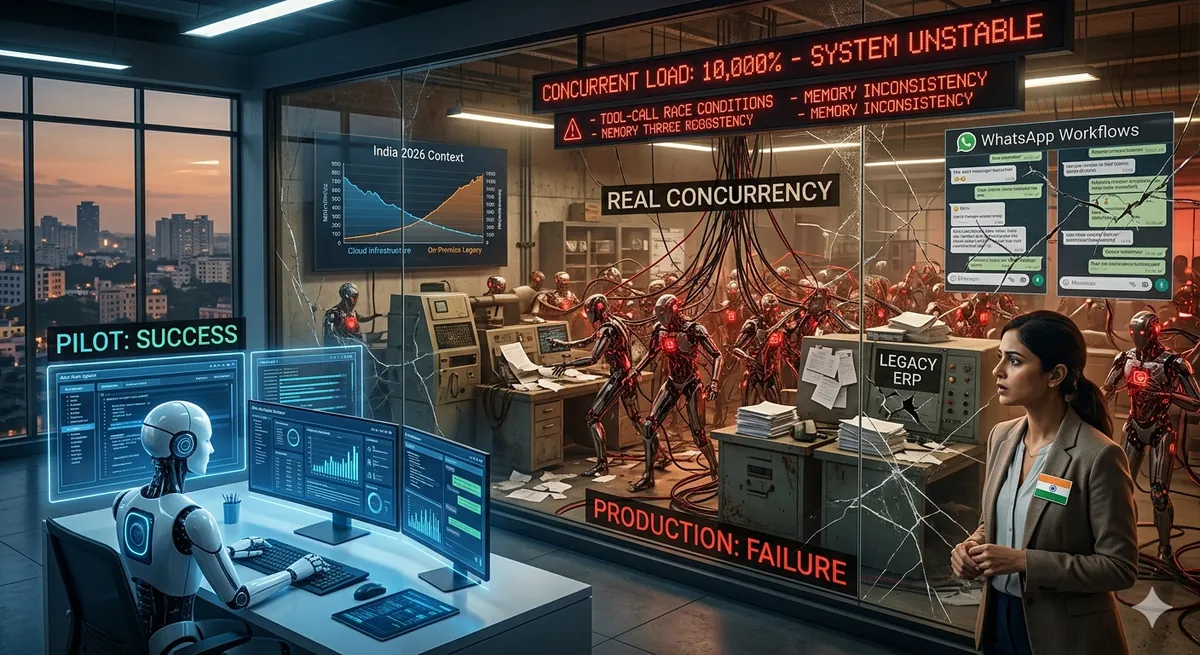
Why Most Enterprise AI Systems That Pass Pilots Are Architecturally Guaranteed to Fail in Production
The Hidden Production Gap in Agentic AI Systems (India, 2026)
Most enterprise AI systems do not fail after deployment.
They fail because of how they are designed before deployment.
The most dangerous pattern in enterprise AI today is this:
systems that perform correctly in pilots are structurally unfit for production load.
Not due to model quality.
Not due to data issues.
But because they are built for controlled environments, not real enterprise concurrency.
1. The Core Misconception: “If It Works in Pilot, It Will Scale”
In pilot environments:
single workflow execution
clean, structured inputs
predictable user behavior
limited system integrations
no cascading failure chains
In production:
multiple agents execute concurrently
systems interact asynchronously
ERP, CRM, and legacy tools respond inconsistently
partial failures cascade across workflows
latency and concurrency constraints emerge immediately
This is not a scaling challenge.
It is a fundamental architecture mismatch problem.
2. The Real Failure Point: Orchestration Under Concurrent Load
Most enterprise AI systems fail at a layer that is rarely tested in pilots:
concurrent orchestration under real system load.
Not intelligence.
Not prompting.
Not model accuracy.
But:
tool-call race conditions
memory state inconsistency across workflows
retry loops under partial failures
context drift in long-running agent chains
uncontrolled fallback execution paths
Pilot environments never simulate this layer realistically.
So systems that “work” in pilots often fail when exposed to real operational traffic.
3. The Hidden Truth: Pilot Success Is Often a False Signal
Most systems that pass pilots are:
architecturally untested for production reality.
Because:
evaluation is based on static datasets
orchestration is not stress-tested
failure recovery is not modeled
system-level chaos is not simulated
So what appears as success is often:
incomplete validation disguised as readiness.
This is why many enterprise AI programs restart after initial deployment attempts.
4. The Economic Cost of Staying in Pilot Mode
A. Pilot Continuation Cost
engineering cycles without production output
repeated vendor coordination loops
dual system maintenance (manual + AI workflows)
B. Time-to-Value Loss
Every delayed production month means:
deferred automation savings
delayed operational efficiency gains
postponed revenue or cost reduction impact
C. Operational Burn
debugging non-production workflows
maintaining fallback manual systems
repeated re-validation cycles
This leads to a silent condition in enterprises:
AI adoption exists, but ROI does not.
5. MCP Has Changed the Problem — Not Solved It
Model Context Protocol (MCP) is becoming the default integration layer for enterprise AI systems.
But a key misconception is emerging:
MCP standardization does not guarantee production reliability.
It solves connectivity.
It does not solve:
multi-agent coordination under load
failure propagation across tool chains
memory consistency across distributed systems
evaluation under dynamic execution conditions
In fact, MCP makes these weaknesses more visible.
6. The Missing Layer: Production-Grade Evaluation
Most enterprise AI systems are evaluated incorrectly.
They are tested for:
correctness in isolated cases
response quality in controlled environments
But not for:
regression behavior under system evolution
multi-agent coordination consistency
adversarial or unexpected input behavior
long-duration state stability
tool failure recovery under load
Without this layer:
production behavior becomes unpredictable.
7. India-Specific Reality That Changes the Architecture
Enterprise AI in India operates under constraints that fundamentally change system design:
Fragmented Data Systems
WhatsApp-driven workflows
Excel-based operations
partially digitized ERPs
Hybrid Infrastructure Environments
cloud + on-premise deployments
regulatory constraints (especially BFSI)
Language & Speech Variability
Hindi-accented English
regional language diversity
inconsistent domain terminology
These conditions redefine:
what “production-ready AI” actually means in India.
8. What Production AI Systems Actually Require
A production AI system is not defined by intelligence.
It is defined by:
deterministic orchestration under concurrency
failure recovery without cascade collapse
evaluation frameworks simulating real load
memory stability across distributed workflows
full observability across agent-tool interactions
Without these:
systems degrade instead of scaling.
9. The Strategic Risk in Most Enterprise AI Programs
Every quarter spent in pilot mode increases:
architectural dependency accumulation
workflow complexity without control systems
evaluation debt across iterations
At a certain threshold:
scaling becomes harder than rebuilding.
This is where many enterprise AI programs silently stall.
10. The Shift Happening in 2026
Enterprise AI is no longer about experimentation.
It is about:
production survivability under real operational constraints.
This is changing:
vendor evaluation criteria
architecture decisions
deployment expectations
evaluation standards
Because the market is converging on a single truth:
AI systems are no longer judged by what they demonstrate — but by what they sustain in production.
11. Strategic Continuation (CTA — Non-Sales, Architecture-Level Trigger)
If an enterprise AI system:
performs correctly in pilots
begins failing under concurrent load
and lacks a formal production-grade evaluation framework
then the real question is not:
“Why did it fail?”
It is:
“Which part of the system is still assuming pilot conditions inside a production environment?”
In most enterprise environments, this question typically surfaces three gaps:
orchestration design not validated under concurrency
evaluation layer not aligned with production reality
failure recovery not designed for cascade behavior
These gaps are rarely visible during pilot success.
They appear only when systems begin scaling across real workflows.
At that point, the critical decision is not whether to rebuild everything.
It is:
whether the current architecture can be made production-reliable without introducing deeper instability.
Most teams at this stage begin by reviewing:
orchestration design assumptions
evaluation methodology gaps
and production failure behavior under load
This is usually the point where engineering teams internally reassess whether their current AI systems are truly production-ready or still operating under pilot assumptions.
Closing Insight
Most enterprise AI systems are not missing intelligence.
They are missing:
production-grade orchestration design
evaluation discipline under real-world conditions
architecture built for concurrency, not demonstration
And until that gap is addressed:
pilot success will continue to remain a misleading indicator of production readiness.