Published May 09, 2026
The Production Paradox: Why Enterprise AI Fails Across Five Layers at Once
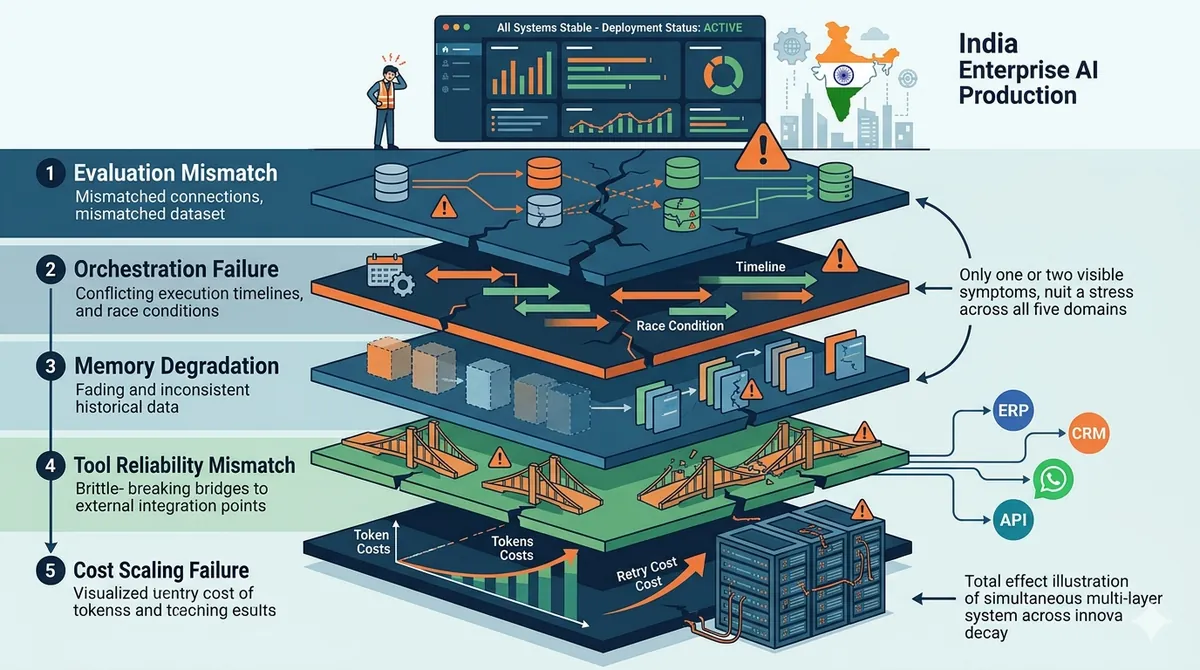
The Production Paradox: Why Enterprise AI Systems Fail Across Five Layers Simultaneously
India Enterprise AI Production Reality, May 2026
Most enterprise AI systems are not failing in one place.
They are failing across five independent system layers simultaneously — but only one becomes visible at a time.
That is why leadership dashboards continue reporting “stable AI progress” while engineering teams quietly accumulate orchestration debt, reconciliation overhead, evaluation gaps, and infrastructure instability underneath the surface.
The system is not collapsing suddenly.
It is degrading asymmetrically across layers that most enterprise teams never evaluate together.
And by the time the visible failure appears, the architectural debt has already spread across the entire operational chain.
This is becoming the defining production pattern in Indian enterprise AI deployments in 2026.
Especially in BFSI, logistics, SaaS, and operations-heavy mid-market environments where AI systems are now being pushed from controlled pilots into real workflow execution under board-level pressure.
The Five-Layer Production Failure Stack
Layer 1 — Evaluation Failure (The False Approval Problem)
Most enterprise AI systems are evaluated in environments that do not resemble production reality.
The evaluation environment is clean.
Production is not.
Typical enterprise evaluation still relies on:
single-turn prompt testing
static datasets
isolated tool calls
manually supervised workflows
limited concurrency simulation
But production introduces:
parallel agent execution
inconsistent API responses
partial tool failures
retry loops
conflicting context states
operational noise from real users
This creates the most expensive AI failure pattern in the market:
The system receives “production approval” despite never being evaluated under production conditions.
The result is not immediate collapse.
The result is delayed architectural instability.
And that instability compounds silently for months.
Real Production Timeline Collapse
One enterprise reconciliation workflow appeared stable during pilot rollout while handling 8 concurrent operations.
By month three, concurrency increased to 60 simultaneous requests across ERP and CRM systems.
The result:
duplicate ERP commits
partial state synchronization
inconsistent financial reconciliation logs
retry loops triggering duplicate tool execution
The visible symptom looked like “API instability.”
The actual root cause was evaluation failure.
The orchestration layer was never stress-tested under production concurrency.
That single mismatch created weeks of reconciliation overhead for finance and operations teams.
Layer 2 — Orchestration Failure (Concurrency Debt)
Orchestration failure is usually the first visible production symptom.
But it is rarely the first problem.
Most multi-agent systems today are architecturally optimized for sequential success — not concurrent reliability.
That distinction matters.
A workflow that succeeds in isolated execution can still fail catastrophically under production concurrency.
Especially when:
multiple agents share state
retries trigger duplicate actions
tools timeout asymmetrically
execution order becomes non-deterministic
Example: The Duplicate Execution Chain
A production operations workflow executes:
Agent A retrieves payment data from ERP
Agent B validates transaction mapping
Agent C updates CRM records
Agent D triggers reconciliation notification
Under production load:
ERP timeout occurs mid-fetch
retry logic activates
Agent C replays previous state
duplicate reconciliation entries are written
CRM now contains conflicting financial records
The dashboard still reports “workflow completed.”
But internally:
operations teams manually reconcile data
engineering teams debug orchestration chains
finance teams lose confidence in AI-generated outputs
This is where enterprise AI systems begin accumulating invisible operational debt.
Layer 3 — Memory Drift (The State Corruption Layer)
Enterprise agent memory becomes unstable long before teams notice accuracy degradation.
This is one of the least discussed production risks in enterprise AI today.
Most systems do not fail because memory disappears.
They fail because incorrect memory persists.
Long-running workflows create:
stale context reuse
conflicting execution assumptions
truncated state chains
corrupted tool references
outdated business logic propagation
The dangerous part:
System confidence often increases while correctness declines.
That creates a high-risk operational condition.
The AI appears stable.
The outputs become progressively unreliable.
In Indian enterprise environments, this problem accelerates because:
workflows span WhatsApp exports
ERP data structures vary between departments
Excel-driven operational overrides bypass system logic
hybrid cloud/on-prem infrastructure introduces inconsistent latency
This creates fragmented state continuity across the orchestration chain.
The AI system begins “remembering” operational assumptions that are no longer true.
Most teams only discover this after downstream business metrics begin drifting.
Layer 4 — Tool Reliability Mismatch (The Infrastructure Illusion)
Enterprise AI systems inherit the instability of every system they connect to.
That includes:
ERPs
CRMs
internal APIs
legacy databases
workflow automation tools
external vendor systems
Most AI architectures assume tool reliability is stable.
Indian enterprise environments rarely operate that way.
Common production conditions include:
intermittent API availability
hybrid cloud/on-prem latency variation
inconsistent schema enforcement
legacy ERP response fragmentation
partial payload returns under load
This creates a dangerous misdiagnosis pattern.
Leadership sees unstable AI outputs.
Engineering teams blame the model.
The actual failure originates in infrastructure inconsistency.
The Operational Consequence
Engineering teams spend months “improving prompts” while the real issue exists inside tool reliability architecture.
The AI system appears “hallucinatory.”
But the orchestration chain is actually consuming incomplete or unstable system states.
That distinction matters because:
one requires prompt tuning.
The other requires infrastructure redesign.
Layer 5 — Economic Scaling Failure (The Hidden Margin Collapse)
This is where many technically functional AI systems become financially non-viable.
And most enterprises discover it too late.
A workflow that appears economically sustainable at pilot scale can become operationally destructive under production load.
Because token economics compound across:
orchestration chains
retry amplification
multi-agent execution
validation loops
memory retrieval layers
Quantified Operational Scenario
A system operating at:
40,000 workflows/month
2% orchestration inconsistency
3-agent execution chains
average retry multiplier of 1.8x
can generate:
thousands of manual reconciliation events monthly
operational review queues across finance and support
hidden engineering maintenance overhead
escalating inference and token costs
The system still appears “live.”
But margin efficiency begins deteriorating invisibly underneath the operational layer.
This is where many enterprise AI deployments quietly become economic liabilities instead of operational accelerators.
MCP Is Not Just a Standard. It Is an Exposure Layer.
Most teams still misunderstand what MCP changes architecturally.
MCP is not simply an integration framework.
It is a system visibility shift.
Before MCP:
tool execution chains were opaque
orchestration failures were difficult to trace
dependency relationships remained hidden
debugging relied on fragmented logs
After MCP:
tool interactions become explicit
execution chains become observable
orchestration dependencies surface immediately
failure attribution becomes structurally traceable
This creates a major market shift in 2026.
Because many systems that appeared “stable” before MCP are now exposing hidden orchestration fragility once execution observability increases.
That is why MCP adoption is accelerating fastest among teams already facing production instability.
It is not just enabling orchestration.
It is exposing architectural weakness.
The India-Specific Constraint Layer
Global AI deployment content still underestimates how structurally different Indian enterprise environments are.
Especially across mid-market BFSI, logistics, and operations-heavy organizations.
Production systems here must operate across:
partially digitized workflows
fragmented operational data
Excel-driven business overrides
WhatsApp-based coordination layers
hybrid infrastructure environments
multilingual operational inputs
on-premise compliance requirements
This changes architecture decisions fundamentally.
A workflow that survives clean API environments in US enterprise systems can fail rapidly inside fragmented Indian operational ecosystems.
Especially once concurrency, orchestration, and distributed execution begin scaling simultaneously.
That is why many globally designed AI deployment models struggle after entering Indian enterprise production environments.
They were optimized for cleaner infrastructure assumptions than reality provides.
The Strategic Decision Fork
If your AI system is already in production today, one of two conditions is likely forming internally.
Scenario A — Economic Leakage
The system appears operational.
But:
reconciliation overhead is increasing
manual supervision remains high
inference costs are compounding
engineering maintenance cycles are expanding
The system works.
But margins are quietly deteriorating underneath it.
Scenario B — Scaling Debt
The system appears stable at current load.
But concurrency growth is already creating:
orchestration instability
memory corruption risk
retry amplification
infrastructure bottlenecks
The next scale increase will expose failures that current evaluation frameworks never tested for.
And by the time they become visible operationally, the architecture debt is already expensive to reverse.
Final Insight
The most dangerous assumption in enterprise AI right now is believing that “working in production” means “production-ready.”
Those are no longer the same thing.
Production readiness in 2026 is not a model quality problem.
It is a multi-layer systems engineering problem involving:
evaluation realism
orchestration reliability
memory stability
infrastructure consistency
economic scalability
Most enterprise AI systems are not failing because the model is weak.
They are failing because the architecture was never designed to survive operational reality at scale.
And in the current market cycle, the companies that identify those failures earliest will not just deploy faster.
They will preserve market timing while competitors spend the next 12 months rebuilding systems that were structurally unstable from the beginning.
CTA — The Operational Question Most Teams Are Avoiding
If your current AI deployment suddenly handled 5x its present concurrency tomorrow:
would orchestration remain deterministic?
would memory remain consistent?
would tool reliability remain traceable?
would unit economics still hold?
would your audit trails survive compliance review?
Most enterprise teams do not discover these answers during deployment.
They discover them after operational trust has already started collapsing internally.
That usually becomes visible first through:
finance reconciliation overhead
customer support escalation spikes
manual validation dependency
engineering firefighting cycles
board-level ROI scrutiny
The dangerous part is that these failures often appear months after the pilot was declared “successful.”
That is why production evaluation in 2026 is no longer about whether an AI system works.
It is about identifying where the architecture begins degrading before scale turns those weaknesses into operational liabilities.