Published May 15, 2026
Why Most AI Automation Projects Fail Before Deployment
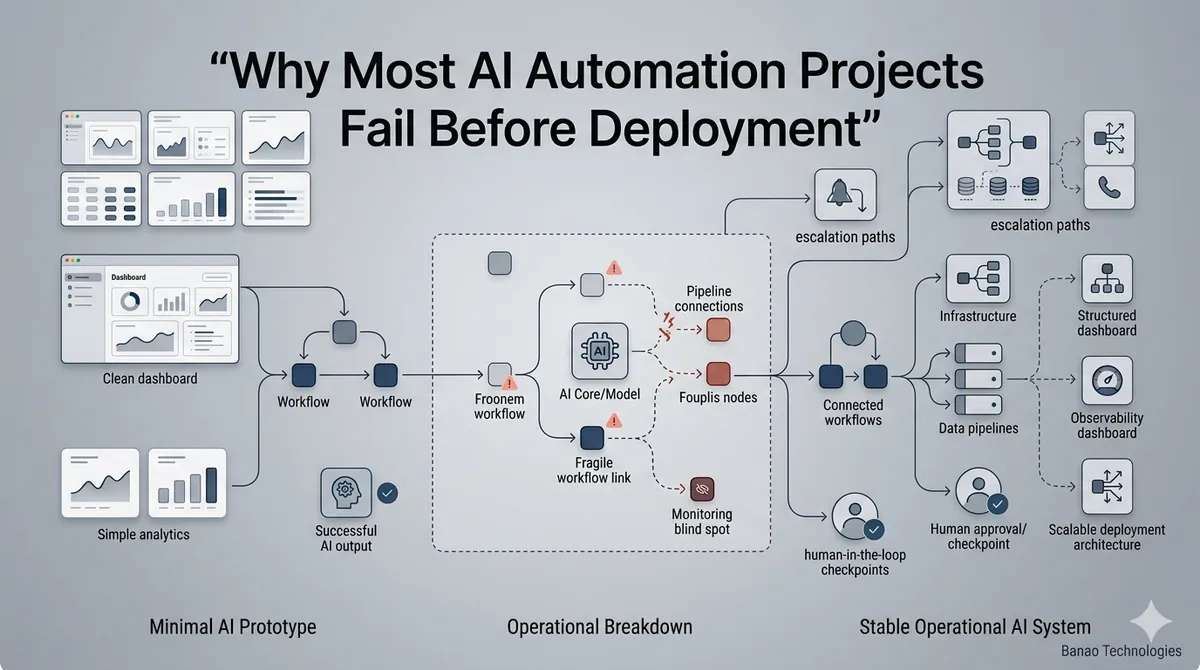
The Number Nobody Talks About
According to McKinsey & Gartner Somewhere between 70% and 85% of enterprise AI projects never make it to production not because the models were wrong, the infrastructure too expensive, or the team unqualified. They failed because of everything around the model: the operational layer nobody designed.
If you're a CTO, VP of Engineering, or enterprise innovation leader who has watched an AI initiative die quietly in staging this is the forensic breakdown of why.
And more importantly, what the architecture that actually works looks like.
Why This Matters Right Now
Enterprise AI adoption is accelerating aggressively.
IDC forecasts global AI spending will reach $632 billion by 2028. Across the USA, UK, UAE, Europe, and India, enterprises are under growing pressure to operationalize AI before competitors build structural advantages.
But the market is entering a dangerous phase.
The race to deploy AI is creating a wave of failed implementations that leave behind something worse than wasted budget:
leadership skepticism
operational distrust
transformation fatigue
resistance to future AI initiatives
The second AI initiative is always harder to fund than the first.
That is why operational AI execution is becoming more important than model experimentation.
The Assumption That Kills AI Projects
Most organizations approach AI automation with a product mindset:
define a use case
select a model
build a feature
ship it
That framing is fundamentally wrong.
“AI automation is not a feature. It is a workflow restructuring exercise that happens to involve a model.”
The model is rarely the hardest part.
The real complexity lives inside:
workflow integration
data pipelines
escalation logic
fallback systems
observability architecture
operational governance
exception handling
cross-functional adoption
The companies deploying successfully do not build isolated AI features.
They build operational AI systems.
This is where companies like Banao Technologies are positioning differently from generic AI vendors and proof-of-concept agencies.
While most providers focus on demos and AI features, operational AI companies focus on deployment resilience, workflow intelligence, and production reliability.
5 Operational Failure Modes of AI Automation Projects
1. The Prototype-to-Production Gap
A proof-of-concept works beautifully on curated data.
Then it collapses in production under:
messy operational inputs
concurrent users
legacy dependencies
edge cases
regional process variation
Most teams optimize for demo performance instead of operational resilience.
There is:
no graceful degradation
no failure-mode mapping
no escalation workflow
no fallback architecture
The result?
The model produces a confident wrong answer, no one catches it, and operational damage compounds silently.
2. Data Pipeline Fragility
Enterprise AI systems depend on operational data flowing across:
CRMs
ERPs
warehouses
APIs
spreadsheets
third-party systems
The model often performs correctly.
The infrastructure around it does not.
Routine operational changes break pipelines:
schema updates
API modifications
inconsistent regional data formats
permission changes
This is why enterprise AI infrastructure matters more than model sophistication.
3. No Human-in-the-Loop Architecture
Full automation is not the starting point.
It is the end state.
Organizations that survive production deployment usually begin with assisted automation models where:
AI handles repetitive workflows
humans manage edge cases
escalation paths are predefined
feedback loops improve the system over time
Projects that skip this phase usually fail under operational unpredictability.
4. Organizational Misalignment
AI projects fail politically as often as technically.
Engineering builds systems for workflows owned by operations teams who were never involved in discovery.
The result:
low trust
shadow workflows
manual overrides
duplicate operational systems
Instead of reducing operational cost, AI adds another operational layer.
Operational AI deployment is ultimately a cross-functional workflow transformation problem.
5. Inadequate Monitoring and Observability
Traditional software monitoring is insufficient for enterprise AI systems.
Most organizations monitor:
uptime
latency
infrastructure availability
But AI systems require additional operational intelligence layers:
output quality monitoring
confidence thresholds
drift detection
escalation triggers
human feedback loops
Without AI observability infrastructure, organizations discover failure only after customers experience it.
Failed vs. Successful AI Deployment: The Operational Difference
Dimension | Projects That Fail | Projects That Deploy |
Starting point | Use case + model selection | Workflow redesign + data audit |
Data architecture | Ad hoc pipelines | Centralised, versioned data layer |
Automation approach | Full automation from day one | Assisted automation with escalation paths |
Stakeholder buy-in | Engineering-led, ops informed late | Cross-functional from discovery |
Monitoring | Uptime and latency only | Output quality, drift detection, feedback |
Failure handling | No graceful degradation | Defined fallback and human handoff logic |
The Banao AI Deployment Readiness Model
At Banao Technologies, operational AI assessments begin before model selection.
The focus is not:
“What model should we use?”
The focus is:
“What operational system is required for AI reliability in production?”
Readiness Dimension | Diagnostic Question |
Workflow Readiness | Is the target process mapped at task level? Are edge cases identified? |
Data Readiness | Are all data sources audited? Schema-consistent? Pipeline stable? |
Escalation Readiness | Is human-in-the-loop logic designed? Are exception paths defined? |
Monitoring Readiness | Output quality tracking? Drift detection? Feedback loops in place? |
Org Readiness | Cross-functional alignment? Operations team buy-in secured? |
The majority of failed enterprise AI projects never move beyond the experimentation stage.
Organizations that reach workflow intelligence maturity are the ones creating long-term operational leverage.
At Banao Technologies, operational AI assessments begin before model selection.
The focus is not:
“What model should we use?”
The focus is:
“What operational system is required for AI reliability in production
Why Operational AI Is Becoming the Real Competitive Advantage
The AI market is rapidly commoditizing at the model layer.
Access to powerful models is no longer rare.
What differentiates enterprises now is:
operational integration
workflow intelligence
AI reliability
deployment speed
observability maturity
infrastructure readiness
US enterprises face competitive acceleration.
European organizations face GDPR and EU AI Act compliance pressure.
UAE enterprises are executing national AI transformation mandates.
India-based companies are scaling AI efficiency across distributed operational systems.
The operational challenge is universal.
The organizations winning in enterprise AI are the ones building operational infrastructure not just experimenting with models.
The Strategic Takeaway
"Most enterprise AI failures are workflow failures disguised as model failures. "The single most important reframe for any AI leader in 2025.
The companies winning at enterprise AI automation have shifted their thinking from "What AI can we build?" to "What operational system do we need to make AI work reliably?" That shift from AI as a product to AI as operational infrastructure is the single most important strategic decision an enterprise can make right now.
US enterprises face competitive acceleration. European teams navigate GDPR and EU AI Act compliance pressure. UAE organisations are executing national AI transformation mandates. India-based teams are scaling AI efficiency across distributed operations. The operational challenge is universal the solution framework is the same.
Is your AI project architected for production or just for the demo? Get a free AI Workflow Readiness Audit from Banao Technologies a structured assessment that identifies deployment risks, data pipeline gaps, and monitoring blind spots before they kill your rollout.
→ Book your audit at Banao Technologies