Published May 09, 2026
Why Most AI Automation Projects Quietly Increase Operational Cost (2026 Enterprise Reality)
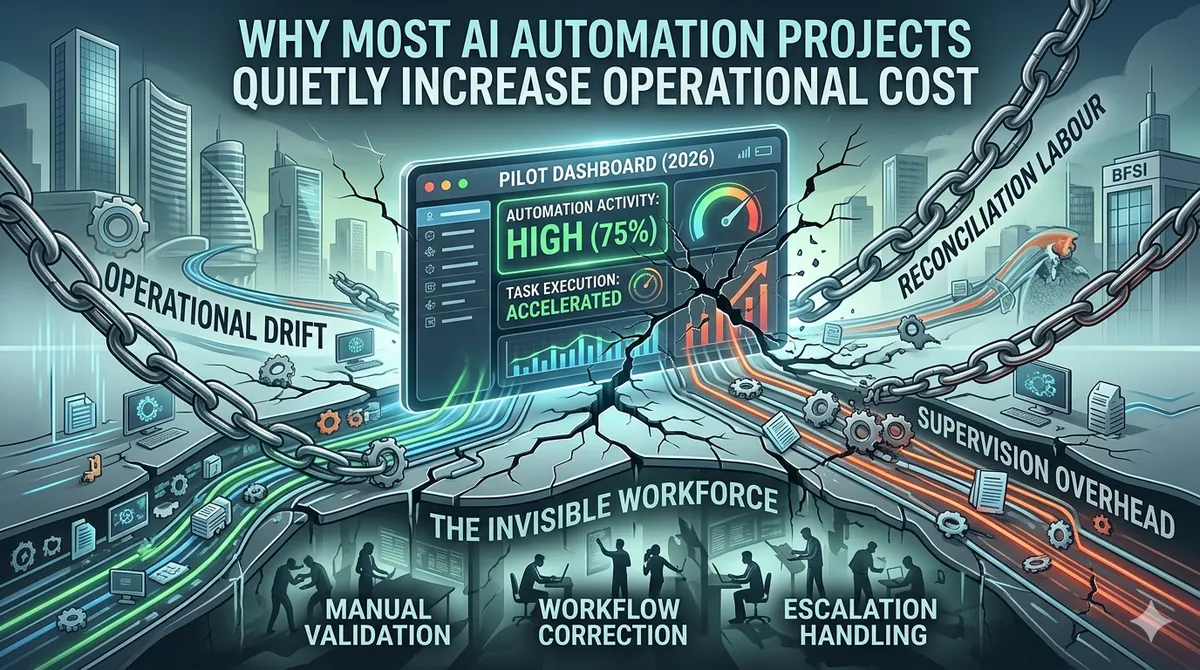
Why Most AI Automation Projects Quietly Increase Operational Cost (2026 Enterprise Reality)
Most AI automation projects do not fail immediately.
They survive just long enough to become expensive.
That is the real operational pattern emerging across Indian mid-market enterprises in 2026.
The pilot launches successfully.
Leadership sees early momentum.
Dashboards show automation activity increasing.
But underneath the visible progress, operational complexity begins compounding faster than the organization can control it.
Six months later, the business discovers something unexpected:
the automation layer reduced task execution time —
while increasing operational supervision cost.
This is the hidden failure pattern most vendors still refuse to discuss.
The Real Problem Is Not Automation Failure. It Is Operational Drift.
Most enterprises assume AI systems fail because models hallucinate.
In production, that is rarely the primary issue.
The larger problem is operational drift.
Small inconsistencies accumulating silently across systems until human intervention becomes unavoidable.
This usually begins gradually:
retry frequency increases
workflows require manual approval checks
escalation paths become inconsistent
operations teams begin validating outputs manually
finance teams notice reconciliation mismatches
support teams start compensating for workflow instability
At first, these appear as isolated incidents.
They are not.
They are symptoms of systemic execution instability.
The “Invisible Workforce” Problem
Most failed AI automation systems create an invisible second workforce inside the company.
Not formally.
Operationally.
People quietly emerge whose entire job becomes:
validating AI outputs
correcting workflow inconsistencies
manually escalating failed states
reconciling partial system execution
monitoring automation reliability
The organization believes automation reduced operational dependency.
In reality, it redistributed it.
This is now one of the largest hidden operational costs in enterprise AI deployment.
Especially across Indian BFSI, logistics, and operations-heavy SaaS environments where workflows depend on fragmented infrastructure.
The Production Failure Most Teams Misdiagnose
One enterprise support workflow reduced average ticket routing time from 11 minutes to under 90 seconds during pilot deployment.
Leadership considered the rollout successful.
Three months later, operational metrics began degrading.
Not dramatically.
Quietly.
As concurrency increased, the orchestration layer began creating inconsistent escalation priority states between CRM workflows and internal ticket assignment systems.
The visible symptom looked manageable:
duplicate escalations.
The actual operational consequence was larger:
support managers manually reassigned tickets
workflow trust declined internally
response SLA variance increased
reconciliation overhead expanded weekly
hiring resumed despite “successful automation”
The model itself was functioning correctly.
The operational coordination architecture was not.
This distinction is where many automation vendors still fail in 2026.
They optimize for workflow acceleration.
Not execution survivability.
Why Operational Cost Quietly Increases After Automation
Most organizations calculate automation ROI incorrectly.
They measure:
reduced handling time
task completion speed
workflow throughput
But they ignore hidden operational accumulation:
supervision overhead
reconciliation labor
escalation correction
compliance validation
observability management
retry-related infrastructure cost
This creates the illusion of operational improvement while margin efficiency deteriorates underneath.
One common pattern:
a system handling 75,000 monthly workflow actions with just 1% execution inconsistency can generate hundreds of human correction interventions every week.
At scale, even minor orchestration instability compounds financially.
This is why some companies experience an uncomfortable contradiction:
automation activity increases —
while operational hiring continues rising.
The Five Failure Layers Most Enterprises Discover Too Late
Operational AI systems rarely fail in one visible place.
They degrade across multiple connected layers simultaneously.
Layer 1 — Decision Drift
The same workflow begins producing slightly different execution behavior across teams, contexts, or time windows.
Trust begins eroding internally.
Layer 2 — Coordination Fragmentation
Systems complete workflows partially.
CRM updates succeed.
ERP synchronization fails.
Now operations teams manually resolve state inconsistencies.
Layer 3 — Retry Inflation
Tool instability introduces cascading retries.
Latency increases.
Infrastructure cost rises silently.
Observability becomes harder.
Layer 4 — Human Dependency Regrowth
Teams begin supervising automation outputs because reliability confidence declines.
This is where “automation” becomes operationally expensive.
Layer 5 — Governance Exposure
Leadership realizes there is no clear audit trail explaining:
why workflows executed
how decisions were made
where failures originated
which outputs were manually corrected
This becomes especially dangerous in regulated environments.
Why Global Automation Playbooks Break in Indian Enterprise Environments
Most AI automation guidance assumes:
clean APIs
centralized systems
structured data environments
cloud-native workflows
Indian enterprise operations rarely function this way.
Production workflows often span:
WhatsApp-originated approvals
fragmented Excel operations
hybrid cloud/on-prem systems
manual escalation chains
regional language communication
legacy ERP infrastructure
These conditions fundamentally change automation architecture requirements.
The challenge is not simply automating workflows.
The challenge is preserving operational consistency inside fragmented infrastructure environments.
That requires a different engineering discipline entirely.
The Strategic Shift Happening Across Enterprise AI
The market is now separating into two categories:
Category 1 — Workflow Automation Vendors
They automate tasks.
They optimize demos.
They focus on visible workflow acceleration.
Most systems struggle under operational scale pressure.
Category 2 — Operational Infrastructure Builders
They engineer:
orchestration resilience
deterministic execution
observability systems
evaluation pipelines
concurrency-safe coordination
recovery-aware architectures
The second category is becoming strategically more valuable in 2026.
Because enterprise buyers are no longer asking:
“Can AI automate this workflow?”
They are asking:
“Will this system still function reliably after deployment expansion?”
That is a fundamentally different buying psychology.
The Self-Diagnosis Most Leadership Teams Avoid
If your operations currently require:
manual AI supervision
workflow correction teams
growing reconciliation overhead
retry-heavy execution paths
increasing latency under scale
additional operational hiring after automation rollout
then one of two realities already exists:
Either:
your automation architecture is accumulating invisible operational debt,
or:
your deployment has already crossed its reliability threshold and the visible breakdown has simply not surfaced fully yet.
Most organizations recognize this only after expansion complexity multiplies.
By then, rebuilding becomes significantly more expensive.
Why This Is Becoming a Board-Level Issue
Operational AI is no longer evaluated as innovation.
It is evaluated as infrastructure.
Boards are now measuring:
operational margin improvement
workflow survivability
execution consistency
scalability without headcount growth
deployment reliability under pressure
This changes vendor evaluation criteria completely.
The most important capability in 2026 is no longer:
“Can this AI system function?”
It is:
“Can this operational system remain economically stable under production-scale complexity?”
That is now the real competitive divide in enterprise AI.
Final Insight: Most Automation Systems Fail Financially Before They Fail Technically
This is the dangerous part.
Operational systems often continue functioning visibly while deteriorating economically underneath.
The workflows still execute.
The dashboards still appear healthy.
But human dependency quietly expands behind the scenes.
That is how operational margins erode despite successful automation metrics.
The companies scaling successfully in 2026 are not necessarily deploying the most AI.
They are deploying the most operationally survivable AI infrastructure.
That distinction is becoming increasingly important as deployment pressure accelerates across the Indian enterprise market.
CTA — The Hidden Operational Cost Most Teams Discover Too Late
Many operational AI systems appear successful during pilot stages because human supervision quietly compensates for orchestration instability.
The real financial problems surface later:
during concurrency growth
under multi-system coordination
across compliance-heavy workflows
when operational scale exceeds human correction capacity
By that point, the projected automation ROI has often already been partially erased by invisible operational overhead.
Banao.tech works with enterprise teams evaluating where orchestration instability, execution drift, reconciliation overhead, and hidden supervision dependency already exist inside operational AI systems before those issues compound into long-term margin pressure.