Published May 15, 2026
Why Most AI MVPs Never Become Scalable Products
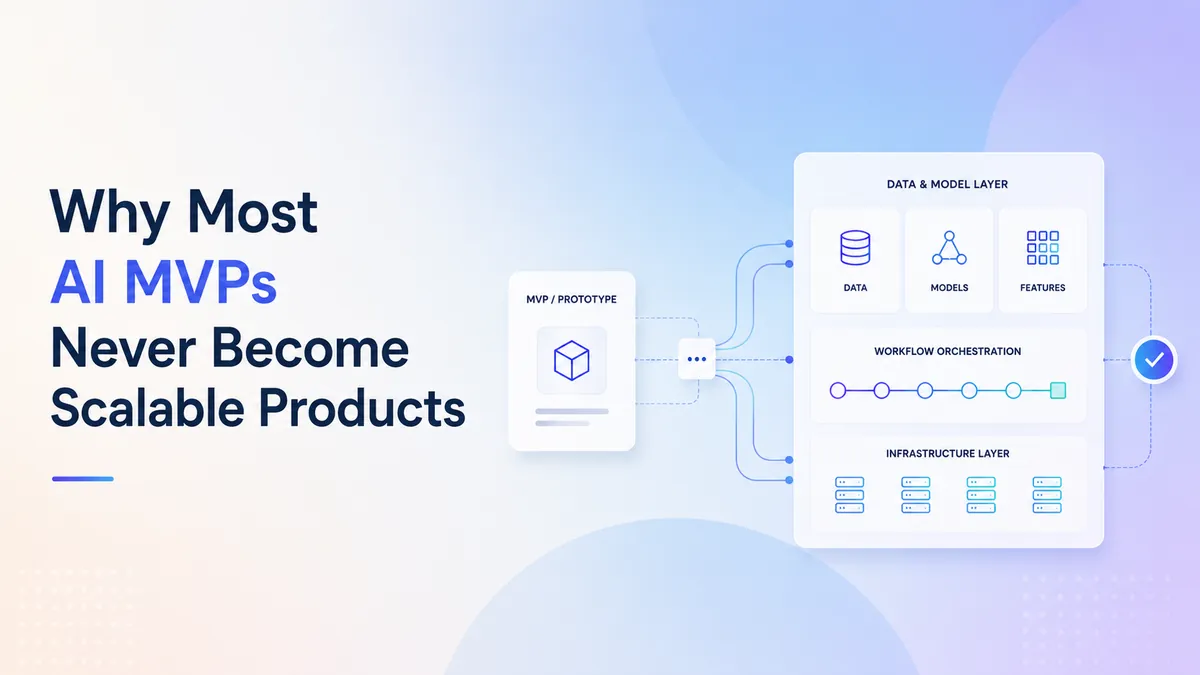
You showed the demo. Everyone loved it. The investors nodded. The team cheered. Your AI MVP worked perfectly in the meeting room.
Then you tried to scale it.
And that's when things got quiet.
Not dramatically quiet. Not a single moment of failure. Just a slow, grinding realisation that what you built to impress people in a boardroom was never designed to survive contact with real users, real data, and real business pressure.
Only 54% of AI proofs-of-concept ever advance beyond the pilot stage, according to IBM Global AI Adoption Index. The majority fail during enterprise AI deployment because operational systems are not designed for scale.
That gap has a name.
At Banao Technologies, we call it the MVP Graveyard. And it's full of genuinely good ideas that were built wrong from the start.
The Demo Is Not the Product
Here’s what nobody tells you when you’re celebrating your MVP launch:
A demo is an argument.
It says:
“This is possible.”
A product is something different.
A product says:
“This works reliably, repeatedly, under operational pressure, for users behaving unpredictably.”
Most AI MVPs are built to win arguments.
They are not built to become reliable AI production systems.
The model is tuned on clean, curated data. The UI is polished for the demo path. Edge cases are handled manually, off-screen, by someone on your team. None of this survives scale.
When real users arrive with messy inputs, unexpected questions, non-English text, legacy system quirks the MVP has no answer. And your team starts spending 60% of their time firefighting the gaps your demo never revealed.
This is the moment most AI products enter what we call:
The MVP-to-Production Collapse
Where the AI itself technically works.
But the operational system around it does not.
Three Reasons the Gap Exists
1. You Optimized for the Pitch, Not the Workflow
Most MVPs prove AI capability.
They do not prove workflow integration.
Users may find the AI impressive, but they stop using it when it fails to fit naturally into daily operations.
2. Your Data Layer Was Never Production-Ready
Most MVP data is:
curated
cleaned manually
operationally stable
Your data layer was never production-ready. The data that powers your MVP is probably hand-selected, pre-cleaned, and sitting in a place your team controls. According McKinsey & Company Real enterprise data is scattered across five to fifteen disconnected systems (McKinsey)
Real enterprise data is fragmented across CRMs, ERPs, APIs, spreadsheets, and legacy systems.
Once real operational complexity enters the system, infrastructure failures begin:
schema changes
API instability
inconsistent formats
broken permissions
The model may work.
The operational infrastructure often does not.
This is why scalable AI infrastructure becomes more important than model sophistication once AI products move into production environments.
3. There’s No Architecture for Failure
There's no architecture for when it gets it wrong Your MVP probably gets it right 85% of the time. That sounds good. But at scale, that remaining 15% represents thousands of users hitting a broken experience daily with no fallback, no human escalation path, and no mechanism to learn from the failure. Gartner AI deployment research identifies absence of error-handling architecture as one of the top reasons AI pilots stall at scale.
"An AI MVP tells you the model works. It tells you nothing about whether your product will."
This is where operational AI architecture becomes critical for long-term scalability.
The Difference Between Demo AI and
Operational AI
Demo AI | Operational AI |
Built for presentations | Built for unpredictable real-world usage |
Optimized for happy-path workflows | Designed for edge cases and operational variability |
Curated datasets | Real-time production data environments |
Manual intervention hidden backstage | Structured escalation and fallback systems |
Success measured by output quality | Success measured by operational reliability |
Focused on model capability | Focused on workflow continuity |
This is the shift most organizations underestimate.
AI scalability is rarely a model problem.
It is an operational systems problem.
The Banao Operational AI Maturity Framework
At Banao Technologies, we’ve observed that most AI products fail because organizations mistake model capability for operational readiness.
Scalable AI products usually evolve across four maturity stages:
Stage | What Happens | Why It Fails |
AI Demo Stage | The model performs well in controlled environments | No real workflow integration |
MVP Stage | Early users interact with the product | Data and edge-case instability emerge |
Operational AI Stage | Human workflows, monitoring, and escalation systems are integrated | Most companies never fully reach this stage |
Scalable AI Infrastructure Stage | AI becomes operationally reliable across teams, workflows, and production environments | Long-term competitive advantage begins here |
Most companies stop at the MVP layer.
Very few build the operational infrastructure required for scalable AI systems.
That is the gap between:
proving AI capability
andbuilding production-grade AI businesses.
What Scalable AI Products Are Actually Built On
The founders who cross the MVP-to-product gap don't have better models. They have better infrastructure thinking.
They start with the workflow, not the model. They ask: what does the user need to complete, and where does AI reduce friction in that completion? Not: what cool thing can AI do that we can demo?
They design for failure before they design for success. What happens when the model returns a low-confidence answer? What triggers a human review? What gets logged for retraining?
And they build data pipelines before they build features. Because an AI product without reliable, clean, real-time data isn't a product. It's a demo with a backend.
This is the work that Banao Technologies does building the operational layer that turns a promising AI MVP into something that actually scales inside an enterprise environment. Not just the model. The system around it.
The Question Worth Asking Right Now
If your best engineer left tomorrow, could your AI product continue to run, improve, and handle edge cases without them?
If the answer is no or even "probably not" you haven't built a product yet. You've built a dependency.
That's not a failure. That's a starting point. But you need to know the difference before you try to scale.
Quick Answers
Why do AI MVPs fail to scale?
Usually three reasons: the workflow integration wasn't designed into the product from the start, the data layer can't handle real-world volume and variance, and there's no architecture for when the model gets things wrong.
What's the difference between an AI MVP and a scalable AI product?
An MVP proves the model works. A scalable product proves the system works including data pipelines, failure handling, workflow integration, monitoring, and user escalation paths.
How does Banao Technologies help with AI product scaling?
Banao Technologies audits your current AI setup across five operational dimensions workflow fit, data readiness, failure architecture, monitoring, and org alignment then builds the infrastructure layer that makes your AI product production-reliable.
The Strategic Takeaway
Most AI MVPs do not fail because the model was weak.
They fail because the operational system around the model was never designed for scale.
That is the critical shift happening in enterprise AI right now.
The market is moving away from:
“Can we build AI?”
and toward:
“Can we operationalize AI reliably?”
That difference will define which companies create long-term operational leverage over the next decade.
Your MVP worked.
Now the real question begins:
Can the system survive production?
Your MVP worked. Now what?
Get a structured AI Product Readiness Assessment from Banao Technologies and identify the operational
gaps preventing your AI MVP from scaling reliably in production.
Book your free audit at Banao Technologies