Published May 09, 2026
Why the Most Dangerous AI Systems in Enterprises Are the Ones That Are Working Perfectly Today
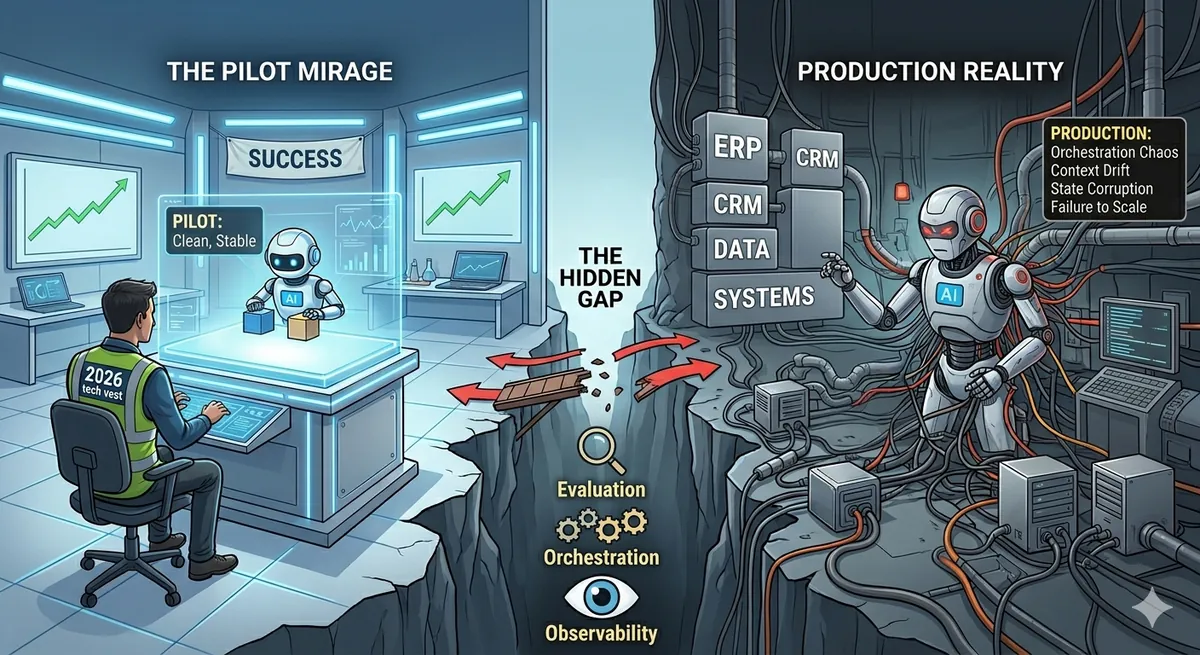
Why the Most Dangerous AI Systems in Enterprises Are the Ones That Are Working Perfectly Today
The Silent Overconfidence Problem in Production AI Systems (India, 2026)
The most expensive failure in enterprise AI is not visible failure.
It is false stability.
Systems that appear stable, pass pilots, satisfy dashboards, and get leadership approval — but silently accumulate architectural debt that only becomes visible under production-scale concurrency.
By the time it surfaces, the system is already deeply embedded in operations.
This is the real failure pattern in 2026 enterprise AI deployments.
1. The Paradox: Working Systems Are Harder to Fix Than Broken Ones
Enterprise AI systems fall into two categories:
Category A — Obvious failure systems
low accuracy
unstable outputs
frequent breakdowns
These are easy to diagnose and fix.
Category B — “Successful” systems
high pilot scores
stable early production rollout
leadership confidence
no visible errors
These are the dangerous systems.
Because they:
create the illusion that the architecture is correct.
But correctness was never tested under real production pressure.
2. The Hidden Mechanism: Stability Without Stress Is Not Stability
Most AI systems are validated under controlled conditions:
single-agent execution
clean input distributions
predictable API responses
no concurrent workflows
no failure chaining
But production behaves differently:
multiple agents execute simultaneously
tools fail partially, not completely
APIs degrade intermittently
workflows overlap across systems
state is continuously mutated
So what is measured in pilots is not stability.
It is:
controlled-condition consistency.
3. Real Production Chain Example (Where Systems Actually Break)
Consider a typical enterprise agent workflow in production:
Step 1 — Trigger
A finance ops request is raised:
reconcile invoices across ERP and CRM for the last 7 days
Step 2 — Agent Planning
System decomposes task:
fetch ERP invoices
fetch CRM payment confirmations
match customer identifiers
flag mismatches
Step 3 — MCP Tool Execution (Concurrent Calls)
ERP MCP tool invoked
CRM MCP tool invoked
billing API triggered
System assumption:
tools are stateless and independently reliable
Step 4 — Hidden Failure 1: Retry Duplication
ERP call times out mid-response.
Retry logic triggers.
But:
first call partially succeeded
second call re-executes write operation
Result:
duplicate invoice reconciliation entries created
Step 5 — Hidden Failure 2: Memory Drift
CRM response arrives delayed.
Agent continues execution with incomplete state.
Result:
12% of paid invoices incorrectly flagged as pending
Step 6 — Final Output (False Success Signal)
System logs:
workflow completed
94% accuracy
no visible errors
But in reality:
financial reporting layer has been silently corrupted.
What actually failed:
Not intelligence.
But:
orchestration concurrency handling
retry idempotency design
cross-tool state consistency
These failures never appear in pilots.
4. Why Pilot Metrics Mislead Leadership
Pilot dashboards typically show:
high task accuracy
low latency
clean execution logs
positive user feedback
But these assume:
isolated execution equals production readiness
Production failure is driven by:
interaction complexity
system coupling
concurrency stress
failure propagation
Not single-task correctness.
5. MCP Didn’t Solve the Problem — It Exposed It
Model Context Protocol (MCP) is becoming the default integration standard.
But its real effect is structural:
Before MCP:
integrations were opaque
orchestration was hidden
system boundaries were unclear
After MCP:
tool interactions are explicit
execution chains are observable
orchestration flaws become measurable
This creates a shift:
systems that appeared stable now reveal hidden fragility under load.
6. India-Specific Constraint Layer That Amplifies Failure
Enterprise AI in India operates under additional constraints:
Fragmented Data Systems
WhatsApp-based workflows
Excel-driven operations
partially digitized ERPs
Infrastructure Variability
hybrid cloud + on-prem systems
regulated BFSI environments
inconsistent latency across services
Language Complexity
Hindi-accented English voice inputs
multilingual operational data
ambiguous domain commands
These conditions accelerate:
small orchestration flaws becoming system-level failures.
7. What Production-Ready Actually Means
A production AI system is not defined by intelligence.
It is defined by:
deterministic orchestration under concurrency
failure recovery without cascade propagation
evaluation frameworks aligned with real system behavior
stable memory across distributed workflows
full observability across agent-tool interactions
Without these:
“production system” is only a deployment label.
8. The Strategic Risk Most Teams Underestimate
Every month spent in pilot-aligned architecture introduces:
hidden orchestration debt
unvalidated dependencies
accumulation of evaluation gaps
At scale threshold:
fixing becomes harder than rebuilding.
This is where many enterprise AI programs silently stall.
9. The Shift in 2026 Enterprise AI
Enterprise AI is no longer evaluated on:
what works in controlled environments
It is now evaluated on:
what continues to work under real concurrent operational load
This is changing evaluation standards:
pilot success is no longer sufficient
architecture design is part of procurement
failure recovery is a buying criterion
evaluation methodology is now a vendor differentiator
10. Strategic Continuation (CTA — Financial + Technical Risk Layer)
When an enterprise AI system shows:
strong pilot performance
stable early production behavior
but emerging inconsistencies under concurrency
the real question is not:
“where is it failing?”
It is:
“what is the cost of continuing to operate a system that behaves correctly in isolated execution but inconsistently under real load?”
Because at scale, these systems do not fail suddenly.
They accumulate operational and financial inefficiency debt across three dimensions:
1. Cost of Delayed Scaling
Every month the system remains partially production-ready:
automation ROI is deferred
manual workflows continue alongside AI
value realization remains unrealized
This creates:
a silent delay in business impact despite technical deployment
2. Cost of Operational Inefficiency Accumulation
Small orchestration inconsistencies lead to:
duplicate processing cycles
manual correction loops
hidden reconciliation overhead
engineering effort spent on stabilization instead of scaling
Individually small.
Collectively:
continuous operational leakage.
3. Cost of Pilot-to-Production Debt
The longer a system remains pilot-structured:
harder it becomes to retrofit concurrency handling
more fragile dependencies accumulate
more expensive stabilization becomes
At a certain threshold:
correction cost exceeds rebuild cost.
Decision Fork Moment
If this pattern exists in your system, then one of two conditions is already true:
either your system is technically functional but economically underperforming
ORyour architecture is accumulating scaling debt that will surface under the next load increase
There is no stable middle state at enterprise scale.
Closing Insight
Most enterprise AI systems are not failing because they are incorrectly built.
They are failing because they are:
validated under non-representative conditions
not stress-tested under concurrency
and evaluated with incomplete production realism
Until this gap is addressed:
pilot success will remain one of the least reliable indicators of production readiness.