Published May 20, 2026
The Hidden Infrastructure Layer Behind Reliable AI Systems
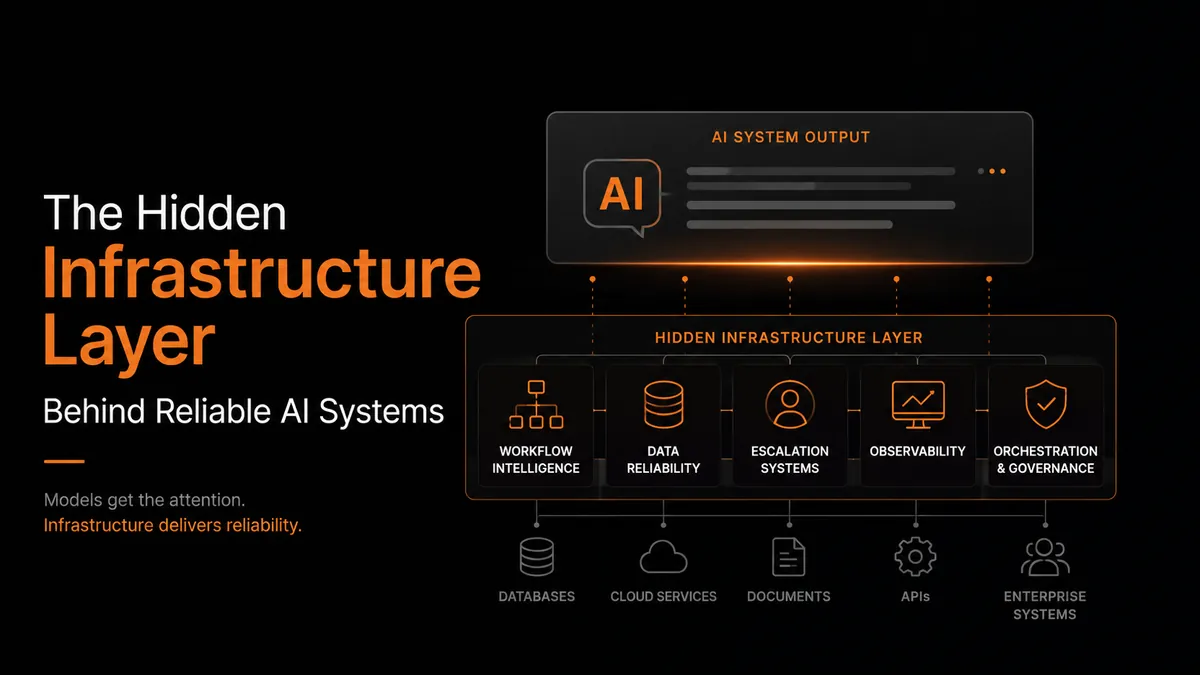
We have audited more than 60 enterprise AI systems over the past two years. The model was the problem exactly twice.
Every other failure every system that worked in staging and broke in production, every AI feature that engineers spent 40% of their time keeping alive instead of building the next thing traced back to the same place.
Not the model. The layer around it.
Everyone asks which LLM to use. That question is about 10% of the operational challenge. The other 90% is what you build around it.
Most organisations have not built that 90%. And they are only discovering it now, which is exactly why so many enterprise AI systems fail after deployment under the pressure of real users, real data volumes, and real business consequences.
What this actually looks like
Here is a scenario that is almost exactly what we see every quarter.
A logistics company in the UAE built an AI document processing system. Twelve months of development. A genuinely capable model. Strong demo. Leadership approved the rollout.
Six weeks into production, the system started producing outputs the operations team didn’t trust. Accuracy had dropped from 91% to 74%. Nobody knew why.
We were brought in for an audit. The model hadn’t changed. The problem was that three regional offices had slightly different invoice formats formats the training data had never seen at production volume. There was no data validation layer, no confidence threshold trigger, no escalation path when the model hit low-certainty inputs. The model kept processing. The outputs kept degrading. Nobody was watching.
The rebuild took 11 weeks and cost more than the original development cycle. The model was fine the entire time.
— Banao Technologies operational audit, 2024 (details anonymised)
Why this keeps happening
1. The demo environment is a lie
Not deliberately. But demos run on curated data, controlled conditions, and human intervention hidden just offscreen. Production environments are none of those things. The moment real users arrive with unexpected inputs and legacy system quirks, the gap between ‘works in staging’ and ‘works operationally’ becomes visible. And expensive.
AI systems don’t fail in demos. They fail six weeks after launch when the third regional data format hits the pipeline and nobody built a fallback for it.
2. Failure architecture is an afterthought
Across our audits, the single most common missing element is not a technical layer it is a design decision. Nobody asked: “what happens when the model is uncertain?” Systems are designed around successful outputs. Production systems constantly encounter the other kind.
In 60+ audits, we have found that over 60% of production AI failures originate in three places: unstable data pipelines, absence of confidence threshold logic, and no monitoring of output quality post-deployment. None of those are model problems.
3. AI gets added to broken workflows
One pattern we see repeatedly: a company automates a workflow that was already inefficient. The AI gets faster. The inefficiency gets faster too. Teams end up manually validating AI outputs, re-entering AI-generated data, and managing duplicate systems. The automation created more complexity than it removed because the workflow itself was never fixed first.
The Banao Operational AI Infrastructure Framework
After the UAE audit above, we needed a structured way to evaluate production readiness before systems went live rather than after they failed. This is what we built.
# | Layer | What breaks without it |
01 | Workflow Intelligence | You automate the wrong things. AI makes inefficiency faster, not smaller. |
02 | Data Reliability | Model accuracy drifts silently as real-world data diverges from training data. |
03 | Escalation Systems | The model processes uncertain inputs with false confidence. Nobody catches it. |
04 | Observability | You discover failures from user complaints, not monitoring. Always too late. |
05 | Orchestration & Governance | As you scale, multiple AI systems conflict, duplicate, and operate with no central oversight. |
The framework is not a checklist. It is a diagnostic. Most systems we audit are strong on Layer 1 and 2 inside demo conditions. They are weak on Layers 3 and 4 in production. That gap is where the failures live.
Demo AI vs Operational AI
Dimension | Demo AI | Operational AI |
Data | Curated, clean, controlled | Messy, multi-format, constantly changing |
Failure | Hidden behind the scenes | Caught by escalation systems before users see it |
Monitoring | None you check when it breaks | Output quality measured continuously |
Success metric | Output quality in the demo | Operational continuity in production |
Uncertainty | Avoided by design | Expected and handled by design |
The competitive advantage in enterprise AI is not model access. Every serious company has the same models. The advantage is whether your infrastructure makes those models operationally reliable.
Quick answers
What is the AI infrastructure layer?
It’s everything around the model: the workflows feeding it data, the systems that handle uncertain outputs, the monitoring that tells you when something is quietly degrading, and the governance that prevents five different teams from running five conflicting AI processes. Most organisations build the model. Very few build the layer.
Why do enterprise AI systems break after deployment?
In our experience across 60+ audits: data pipeline instability is the most common cause, followed by absence of escalation logic for uncertain outputs, followed by no output quality monitoring. Model performance is rarely the root cause. The surrounding infrastructure almost always is.
How long does it take to fix?
That depends entirely on which layers are missing. Systems with strong workflow design but weak observability can be remediated in 4–6 weeks. Systems with fragile data infrastructure and no escalation logic typically require 10–16 weeks of structured remediation. The audit tells you which situation you’re in before you commit to either.
Is your AI system operationally reliable or just technically functional? Book a free 30-minute AI Infrastructure Readiness Audit with Banao Technologies . We map your system across all five layers of the Banao Framework and deliver a written risk report within 48 hours. No sales pitch. No commitment. Just a clear picture of where your production risks actually are. Most of the systems we audit have active production risks they just have no observability layer to detect them yet Book your free audit at Banao Technologies |