Published May 15, 2026
Why Most AI Products Create More Workflow Complexity
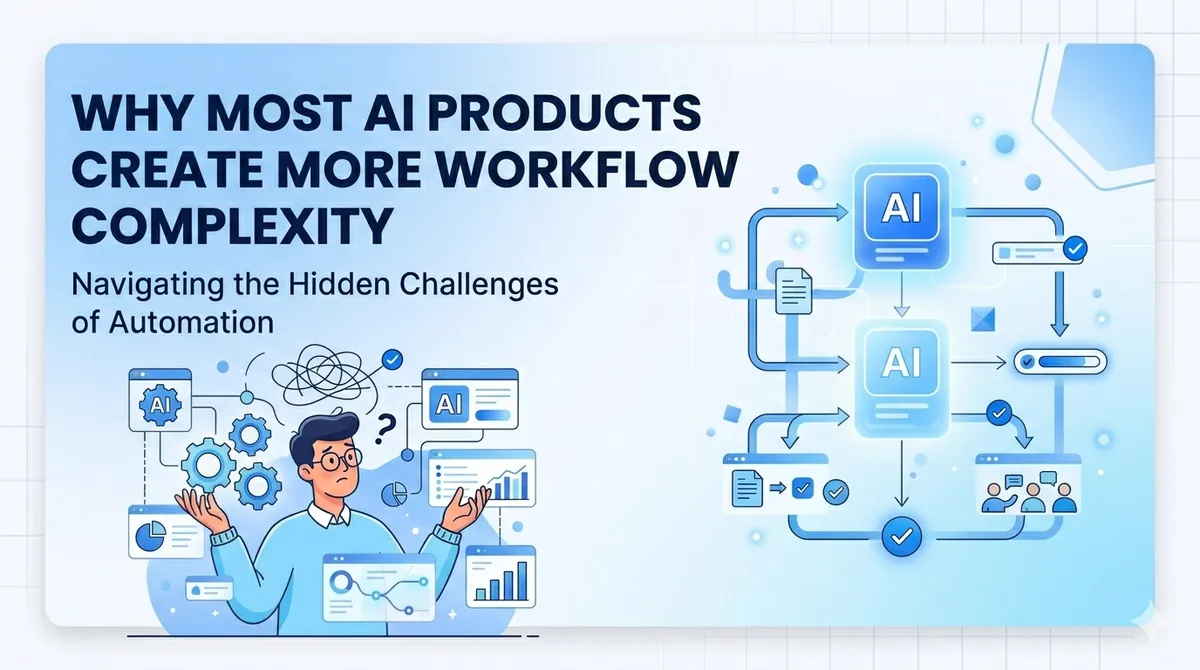
You Bought AI. Your Team Is Now Doing More Work.
Sound familiar?
You adopted an AI tool. Leadership approved the budget. Everyone was excited. And three months later your team is managing the AI tool on top of the process it was supposed to replace.
This isn't a niche problem. According to McKinsey's 2024 State of AI Report, most organisations report that AI adoption created new coordination overhead before it delivered efficiency gains.
The promise was simplicity. The reality is more tools, more handoffs, more things to monitor and the same underlying problems.
Why AI Adds Complexity Instead of Removing It
There's a pattern across almost every organisation that hits this wall. It usually comes down to three things:
1. AI was dropped onto an existing broken workflow
• The root process was never mapped or fixed.
• AI automated the chaos it didn't replace it.
• Result: two systems running in parallel, with humans managing both.
2. The tool doesn't connect to where work actually happens
• Most off-the-shelf AI tools are siloed they don't integrate cleanly with your CRM, ERP, or existing stack.
• Teams export data manually to feed the AI, then re-enter outputs downstream.
• According to Gartner, poor data integration costs enterprises an average of $12.9 million/year.
3. Nobody designed the human-in-the-loop layer
• AI outputs land somewhere, but no one defined who reviews them, when, and how.
• Trust is low. So humans check everything manually which defeats the purpose.
• New verification steps appear. The workflow gets longer, not shorter.
"AI doesn't create complexity on its own. Humans create complexity by adding AI to workflows that were never designed to receive it."
The Gap Between the Promise and the Reality
❌ What AI Was Supposed to Do | ⚠️ What Actually Happened |
Automate repetitive tasks | Teams now manage the AI tool on top of the old process |
Centralise data and decisions | Added a new platform that doesn't talk to existing systems |
Speed up approvals and handoffs | Created new handoff steps to verify AI outputs |
Reduce manual work | Shifted manual work upstream to 'prepare data for AI' |
Give teams more clarity | Produced more outputs most of which no one trusts yet |
The Hidden Cost of AI Complexity
Most enterprises expect AI to reduce operational friction immediately. But without workflow redesign, integration architecture, and escalation logic, AI often introduces a second operational layer instead of removing the first.
Signs Your AI Is Adding Overhead, Not Removing It
Quick check how many of these are true for your team right now?
• Your team exports data manually to feed the AI tool
• AI outputs get re-checked or re-entered somewhere downstream
• You've added a new 'review' or 'approval' step since adopting AI
• The old manual process is still running alongside the new AI process
• Nobody's sure what to do when the AI gets it wrong
• The tool works in isolation but doesn't talk to your main systems
If three or more of these sound familiar you don't have an AI problem. You have a workflow architecture problem.
Why This Problem Is Growing Faster in 2025
The current AI market is creating a dangerous operational pattern inside enterprises.
Teams are adopting multiple AI tools rapidly across:
operations
support
analytics
internal workflows
customer communication
But most organizations still lack:
centralized AI governance
workflow orchestration
operational observability
escalation architecture
integration standardization
As a result, enterprises are unknowingly creating fragmented AI ecosystems where every new AI tool adds another coordination layer instead of reducing operational complexity.
This is why the market is now shifting from:
“Which AI tool should we buy?”
to:
“How do we operationalize AI across the business without creating workflow chaos?”
How High-Performing Enterprises Actually Reduce AI Workflow Complexity
Organizations successfully scaling AI in production follow a fundamentally different operational approach.
They don't start with the tool they start with the workflow.
Step 1 — Map the workflow before touching the AI
• Identify which steps are rule-based vs. judgment-based
• Find where errors and delays actually occur
• This is the step most teams skip it's also the most important one
Step 2 — Fix the data layer first
• AI is only as reliable as the data flowing into it
• Audit every source the AI will touch before building integrations
• Read: Why Enterprise AI Fails Across Five Layers at Once
Step 3 — Define the human-in-the-loop logic explicitly
• What does the AI handle autonomously?
• What triggers a human review?
• What happens when the AI is wrong?
• Design this before go-live, not after
Step 4 — Measure output quality, not just uptime
• Traditional monitoring (uptime, latency) misses AI-specific failures
• Track: output accuracy, confidence thresholds, user override rates
• If output quality isn't measured, you won't know when it degrades
The Banao Operational AI Framework
At Banao Technologies, we specifically work with teams who adopted AI and found it created overhead instead of removing it. Before recommending any new tool or rebuild, we run a Workflow Complexity Audit across five areas:
Layer 1 — Workflow Mapping
Is the underlying operational workflow actually automation-ready?
Layer 2 — Integration Architecture
Does the AI connect deeply into operational systems or sit in isolation?
Layer 3 — Human Escalation Logic
What happens when the AI becomes uncertain?
Layer 4 — Operational Observability
Can the organization monitor output quality and workflow degradation over time?
Most teams are strong on one, weak on the rest. That imbalance is usually the source of the overhead. Our AI workflow and operational AI services are built specifically to close those gaps.
The Real Enterprise AI Shift
The AI market is rapidly commoditizing at the model layer.
What increasingly differentiates enterprises is not access to AI models — but the ability to operationalize AI reliably across workflows, systems, and teams.
The companies creating long-term advantage are not deploying more AI tools.
They are building operational systems that allow AI to scale without increasing organizational complexity.
Why this change:
Adds strategic depth
Makes the article feel more premium
Aligns with enterprise AI infrastructure narratives dominating current market trends
Stronger competitor-level positioning
The Takeaway
"AI doesn't simplify workflows by itself. Workflow simplification is a design decision that has to happen before, during, and after AI deployment — not as an afterthought."
The question isn't whether to use AI. It's whether your workflows were designed to actually benefit from it.
Most weren't. That's fixable but only if you diagnose the right problem.
Is AI reducing your team's workload or quietly adding to it? Get a free Workflow Complexity Audit from Banao Technologies a structured review of where your AI tools are creating overhead and exactly what to do about it.
→ Book an AI Workflow Complexity Assessment Banao Technologies