Published May 18, 2026
AI Infrastructure Debt: The Silent Killer of Fast-Growing Startups
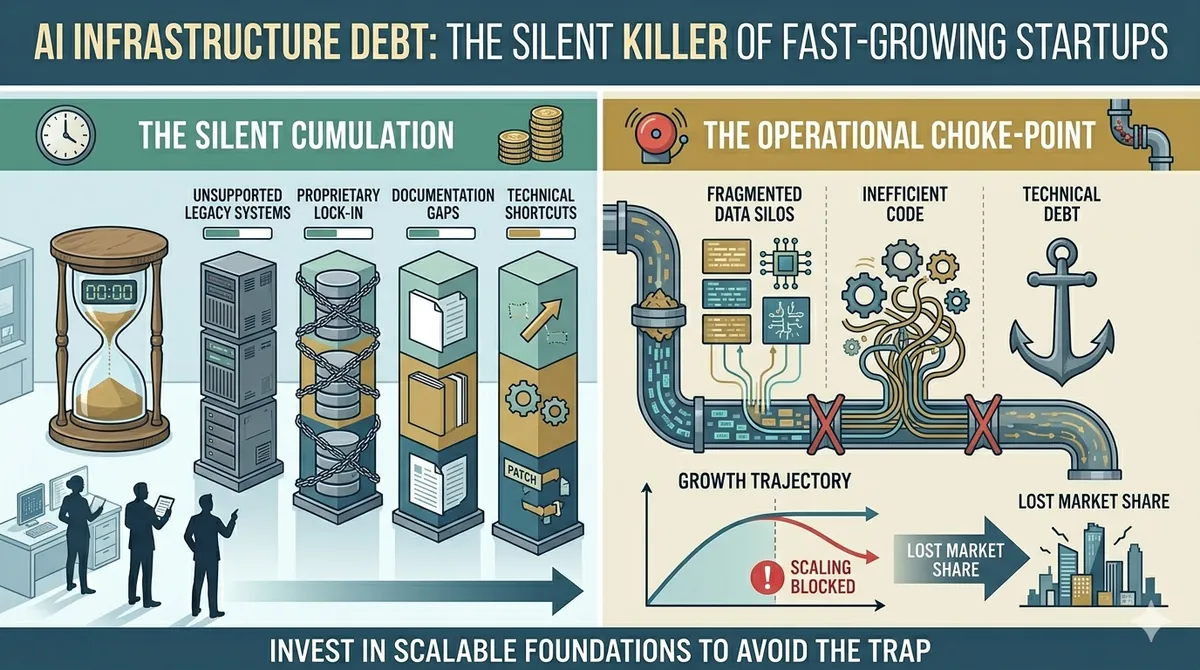
You shipped fast. The demo worked. Investors nodded.
And somewhere between Series A and your next milestone, everything became inexplicably slow, expensive, and fragile.
It wasn’t your team. It wasn’t market timing.
It was your AI infrastructure and the debt you didn’t know you were accumulating.
“Technical debt has a name in engineering standups. AI infrastructure debt doesn’t until it starts costing you £40K/month in unexpected LLM bills or a critical pipeline fails silently in production.”
What Is AI Infrastructure Debt?
Traditional technical debt = messy code.
AI infrastructure debt is different. And worse.
It’s the gap between how your AI systems were built (fast, POC-mode, demo-ready) and how they need to operate at scale (reliable, cost-attributed, observable, fault-tolerant).
It shows up as:
▶LLM calls hardcoded with no fallback or retry logic
▶Prompt logic scattered across 12 different files with no versioning
▶Zero cost attribution: Nobody knows which feature burns your OpenAI budget
▶No rate-limit handling, circuit breakers, or graceful degradation
▶Evaluation frameworks that don’t exist: You’re guessing if outputs are good
▶No tracing, no telemetry, no observability layer
These failures rarely appear during MVP stages. Most emerge only after AI systems enter production environments at scale.
(Read: Why Most AI MVPs Never Become Scalable Products)
Architecture Visual: How Stacks Evolve
Most startups build the left column and only discover they need the right column when scale exposes every shortcut they took.
MVP AI Stack | Scaling Failure Points | Operational AI Stack |
|---|---|---|
Single hardcoded LLM call | Latency spikes under load | Abstracted LLM routing layer |
Prompts scattered in codebase | Prompt changes break production | Centralised prompt registry |
No fallback / retry logic | LLM bills 3× with no visibility | Fallback + graceful degradation |
No cost attribution | Zero root-cause diagnosis | Per-feature cost dashboards |
No output evaluation | Output quality unknown at scale | Automated eval loops |
No observability layer | Engineers fear touching AI layer | Full tracing + observability |
The middle column Scaling Failure Points is where most Series B engineering conversations happen.
Most enterprises discover these operational gaps only after deployment pressure exposes weaknesses across workflows, integrations, and monitoring systems.
(Read: Why Most AI Automation Projects Fail Before Deployment)
What It Actually Looks Like: A Real Scenario
Scenario: Series B SaaS, ~180 employees, AI document processing feature
Built in 2 weeks for a board demo. Shipped to production 3 months later with minor tweaks. Now processing 4,000 documents/day.
▶LLM costs went from £2K to £14K/month. No one can explain why.
▶A prompt change for one client broke outputs for three others. No test coverage.
▶Latency hit 12 seconds per doc under load. Users stopped using the feature.
▶Senior engineer left. The entire AI pipeline was only in his head.
The rebuild took 14 weeks and cost more than the original 2-year AI investment. This is not rare.
The 4 Layers of AI Infrastructure Debt
Every AI infrastructure audit at Banao Technologies maps debt across four layers. Most startups are blind to all four until one of them breaks.
Layer | What Accumulates | Debt Signal | |
01 | Prompt Layer | Unversioned prompts, no registry, no eval harness, logic duplicated across services | Prompt change breaks 3 other features. No rollback. |
02 | Orchestration Layer | Monolithic LLM calls, no routing logic, no fallback chains, no model abstraction | Single provider outage takes down entire AI feature set. |
03 | Observability Layer | No telemetry, no output quality metrics, no latency tracing, no cost attribution | You discover degradation from a support ticket, not monitoring. |
04 | Cost Layer | Token usage untracked per feature, no budget thresholds, no model tiering strategy | LLM bill 4× at Series B. Root cause: unknown. |
How Debt Compounds: The Spiral
Stage | What You Did | What It Costs Now |
Seed | Hardcoded GPT-4 call to ship MVP fast | 2× LLM cost, no fallback, no eval |
Series A | Scaled users without refactoring AI layer | Latency spikes, cascading failures under load |
Series B | Added more AI features on unstable foundation | Engineers spend 40% time firefighting, not building |
Series C | Tried to optimise no observability data to diagnose | Can’t find root cause. 14-week rebuild starts. |
5 Warning Signs You Already Have It
You don’t need an audit to spot this. If three of these are true, you have a structural problem:
⚠️AI costs went up 3× but output quality didn’t
⚠️Engineers fear touching the prompt layer because it breaks other things
⚠️No one knows which LLM call is responsible for which user-facing output
⚠️Your AI pipelines have no logging, tracing, or token-level observability
⚠️You’ve switched LLM providers twice and each migration cost 2-week sprints
“The startups winning at AI are not using better models. They’re running better infrastructure. The model is 10% of the problem. The layer around it is 90%.”
The Fix: Phased Infrastructure Remediation
The best operational AI teams we work with don’t rewrite everything. They remediate in phases:
▶Phase 1: Audit map every LLM call, its cost, latency, output quality, and ownership
▶Phase 2: Isolate move prompt logic into a centralised, versioned registry
▶Phase 3: Instrument add telemetry, tracing, and cost dashboards per feature
▶Phase 4: Harden introduce fallback routing, circuit breakers, graceful degradation
▶Phase 5: Evaluate build automated eval loops before any prompt ships to production
This is what AI operational transformation actually looks like. Not the hype. The plumbing.
AI infrastructure debt rarely exists in isolation.
It usually appears alongside:
• workflow fragmentation
• deployment instability
• observability gaps
• operational AI complexity
Related reads:
· AI SaaS Development: How Intelligent SaaS Platforms Are Redefining Modern Software Businesses
· Why Most AI Automation Projects Quietly Increase Operational Cost (2026 Enterprise Reality)
Ready to audit your AI stack before it audits you? Most AI infrastructure debt is invisible until it’s expensive. Banao Technologies runs a free 30-minute AI Infrastructure Audit mapping your Prompt, Orchestration, Observability, and Cost layers. We’ll identify your top 3 debt points and give you a clear prioritisation framework. No sales pitch. → Book your free AI Stack Audit Banao Technologies |